Showing posts with label autumn olive. Show all posts

Monday, August 29, 2016

Autumn Olive [Elaeagnus umbellata] Jam


This year I've had a bumper crop of autumn olives.   We have several wild trees and the one across the way is huge and covered with berries.  They're good this year.   Even the dog will strip ripe berries from the lowest branches.  


With all that abundance, I thought you might like a quick list of the lovely jams you can make with these wonderful berries.

Elaeagnus Raspberry Jam [my favorite!]

Once you've made the jam, here's a great recipe for Eric's Jam Bars.  Delish!


And if you're wondering what the heck autumn olives are in the first place, check out this post.


Sunday, August 31, 2014

Elaeagnus [Autumn Olive] Raspberry Jam

I'm shameless.  I saved the best for last.

As you know, I've been doing a lot of new jams this year using the abundant elaeagnus [autumn olive] berries around here.  I'm happy to say that the family has loved every single one of them.  However, this one was truly a jam home-run.

I mixed the elaeagnus with red raspberries to see if it would be anything like the cran-raspberry stuff you get at the store.  [You can make jelly out of the cran-raspberry juice at the store by using this method here.  It's fabulous!]   It worked.  

Oh. My. Sweet. Buttered. Biscuits.

This jam. 

This Jam

Come to mama.   As soon as the first jar was emptied, someone opened a second [so it's a good thing I made 2 batches of this one!]

Elaeagnus [Autumn olive] Raspberry Jam
www.rurification.com

2 cups elaeagnus [autumn olive] pulp [for directions on getting the pulp, see this post]
2 cups red raspberries [fresh or frozen]
3 tablespoons low sugar pectin
2 - 3 cups sugar 

Combine elaeagnus, raspberries and pectin in a large pot. Bring to a hard boil [one that you can't stir down.] Boil one minute, stirring constantly.   Add sugar and stir well.  Bring to hard boil again stirring constantly.  Boil one minute.   Ladle into jars and cover with clean lids and rings.  Process for canning.

This jam is very acidic and is very safe for canning.  Makes about 5 cups.

Note:  I used 3 cups of sugar and it's pretty sweet.  If you want to use less sugar, I think you might be able to try it with only 2 cups.  Taste it before you do the final boil to see if you need more sugar and add to taste.

Thursday, August 28, 2014

Elaeagnus [Autumn Olive] Apple Jam

I've been experimenting with Elaeagnus [autumn olive] and other fruit in jam this year.   Since elaeagnus are a bit similar in flavor and tartness to cranberries, I knew I'd have to try an Elaeagnus Apple Jam.

It's heaven in a jar.  Everyone in the family loved it.  I'm thinking this would be a fabulous jam to use as a glaze on ham.   Or chicken.   Or those meatball thingies that you make in the slow cooker.   Yes!

To make it easier to make, I used apple juice concentrate from a can in this jam instead of fresh apples and since that stuff is pretty sweet, I cut the sugar down to 2 cups.  It's perfectly sweet-tart just like cran-apple juice.


Elaeagnus [Autumn olive] Apple Jam
www.rurification.com

2 cups elaeagnus [autumn olive] pulp [for directions on getting the pulp, see this post]
1 can apple juice concentrate
3 tablespoons low sugar pectin
2 cups sugar 

Combine elaeagnus, apple juice concentrate and pectin in a large pot. Bring to a hard boil [one that you can't stir down.] Boil one minute, stirring constantly.   Add sugar and stir well.  Bring to hard boil again stirring constantly.  Boil one minute.   Ladle into jars and cover with clean lids and rings.  Process for canning.

This jam is very acidic and is very safe for canning.  Makes about 5 cups.

If you don't want to use apple juice concentrate, you can use 2 cups of applesauce instead.   And if you want to use fresh apples, then peel and core 2 apples and cook them until soft.  Then make the jam. 


Tuesday, August 26, 2014

Elaeagnus [Autumn Olive] Peach Jam

As I mentioned in my last post, it's elaeagnus season. [The common name is autumn olive, but there is nothing remotely olive-y about these.]  Pick them when they are dark red and softening up.  They should fall off the clusters easily when they are ripe.

This year I realized that elaeagnus are really the hoosier equivalent of cranberries in tartness and that they'd probably be pretty darn good in mixed fruit jams, just like cranberry juice is beloved in mixed fruit juices.   I decided to start there.

It's easy to find cran-apple and cran-raspberry juice mixes at the store, so I put those combinations on my Mixed Fruit Elaeagnus Jam To Make list right away.  Then I saw a recipe for Cranberry Peach Jam somewhere [sorry, can't remember where...!] and thought I should try that one, too. 

And I did.   And it was marvelous.   The elaeagnus berries have a sort of spicy undertone and the finished jam has the flavor of a gently spiced peach jam with the extra oomph of the tart elaeagnus, too.   We loved it!

I mixed the elaeagnus half and half with the other fruit - you can adjust proportions as you wish.   One thing to remember - don't skimp on the sugar with elaeagnus.  It's tart!   I have found that using equal parts sugar and elaeagnus makes for an excellent jam.  I also add in half as much sugar as extra fruit for a jam that is sweet without being candy.   Here's what I did for the Elaeagnus Peach Jam.  

Elaeagnus [Autumn olive] Peach Jam
www.rurification.com

2 cups elaeagnus [autumn olive] pulp [for directions on getting the pulp, see this post]
2 cups chopped peaches
3 tablespoons low sugar pectin
3 cups sugar 

Combine elaeagnus, peaches and pectin in a large pot. Bring to a hard boil [one that you can't stir down.] Boil one minute, stirring constantly.   Add sugar and stir well.  Bring to hard boil again stirring constantly.  Boil one minute.   Ladle into jars and cover with clean lids and rings.  Process for canning.

This jam is very acidic and is very safe for canning.  Makes about 5 cups.

Stay tuned for the recipes for Elaeagnus Apple Jam and Elaeagnus Raspberry Jam later this week.


Sunday, August 24, 2014

Autumn Olive Season

Our Elaeagnus [pronounced Elly Agnus] berries are ripening all over the place.   The ones at the top of the hill ripen faster than the ones in other places and it's a good year for them so the three of us grabbed buckets and spent a happy half hour harvesting. 

Really ripe berries will just fall off the clusters into your buckets.    Those are the sweetest ones. 

Once you get the berries, you can cook them up and sieve the seeds out [see link above] and then make fabulous stuff with the pulp.    Yum!

You need to know a couple of things about these berries.

1.  They're tart!   Don't skimp on the sugar.   If you're making up your own recipes, then you need enough sugar for the grey-ish juice to turn red.   If you don't have enough sugar, you'll still see sort of a gray juice hanging around near the top.   Add just enough sugar for that to go away.   I generally use as much sugar as I have elaeagnus pulp in the recipe. 

2.  They vary on how much pectin is in them from year to year.   The first year I made jam with them, I used pectin and it made a super hard jam.   The next year I didn't use pectin and it was perfect.   Last year I made jam with no pectin and it's still runny.   This year I used less pectin than normal and got a good jam, not too hard.     You can use a greater percentage of unripe berries to increase the pectin, but then you'd better use more sugar [see #1.]

Here's last year's recipe for Elaeagnus Orange Ginger Jam.  I have a recipe with pectin and a recipe without. 

I've been experimenting this year, so stay tuned for recipes for these awesome mixed fruit jams with elaeagnus, coming up in the next week. 

[UPDATE:   Here are the links to these recipes]

Elaeagnus (Autumn Olive) Peach Jam
Elaeagnus (Autumn Olive) Apple Jam
Elaeagnus (Autumn Olive) Raspberry Jam

They are all delicious combinations and have passed the family taste test with rave reviews.   Who knew these wild berries would be so versatile?!


Tuesday, January 28, 2014

Tree Damage

My favorite autumn olive tree [Elaeagnus umbellata] was laid low by the recent winter troubles.    All that heavy snow just after the new year bent it right over.   The bending isn't a problem except that a lot of splitting occurred, too and around here that just means disease for a tree.  This tree has a date with the chain saw.


This is some of the damage.

Split limb.


The main trunk, laid on its side, split.


Here's the base of the main trunk - split pretty badly.  If you blow the pic up, you can see a lot of bird damage, too.   The woodpeckers and sap suckers must really love this tree.


Here's a close up of some of those bird holes.  I think they look pretty cool.


We'll try to salvage part of the tree.  It's a good bearer - thornless, too - and I don't want to lose it.

Saturday, September 14, 2013

Eric's Jam Bars

Every jam-maker has a few batches of jam that just never quite set up the way they're supposed to.   Runny jam is a reality that we all have to deal with now and again.  

Eric loves runny jam.   It's usually thicker than syrup and he considers it much easier to bake with than regular jam.   Plus, it's easier to use on waffles with yogurt.  Plus it's good without the waffles on yogurt.   Or ice cream.

And all sorts of other things.

Like this riff on Lemon Bars.   Only they're not Lemon Bars, they're Elaeagnus Orange Ginger Marmalade Bars.  Because that jam never quite firmed up all the way.   A perfect chance to experiment with some new recipes!   And these are amazing. They disappeared fast!

Eric's Jam Squares:  Elaeagnus Orange Ginger Marmalade Bars
www.rurification.com

Crust:
  • 1/2 cup butter, softened 
  • 1/4 cup white sugar
  • 1  cup all-purpose flour 
 Filling
  • 4 eggs
  • 1/4 cup all-purpose flour
  • 1 pint jam  [or 2 jars, 8 oz. each]
 Preheat the oven to 350.

Mix the butter, sugar and flour well.   Eric used a food processor.   Press the crust into the bottom of a 9x9 square pan.  Bake empty crust until golden - 15 minutes or so.

While the crust is in the oven, beat the eggs, flour and jam together well.   When the crust is done, pour the filling in and bake for an additional 20 - 25  minutes.  Keep an eye on it; you don't want it to brown.  

Remove from oven and cool completely.   Sprinkle with powdered sugar.

Want the recipe for the Elaeagnus Orange Ginger Marmalade and a whole lot of other terrific jam recipes?   Check out my ebook:  A Simple Jar of Jam  at www.rurification.etsy.com.   You can preview the book by clicking the link on the sidebar.

Thursday, August 15, 2013

Elaeagnus Ripening

The autumn olive berries are starting to turn red.   It'll be a bumper crop year and the birds are already stripping some of the trees, which I totally don't get because those things are seriously puckery.   I wait until they turn red and start getting soft before I harvest.  

I'm trying to decide what to make with them this year.   More jam for sure, but maybe a mixed jam, too?   Elaeagnus strawberry?   1 part elaeagnus to 3 parts strawberry....  or peach?   Or blueberry?   Or elderberry?    Hmmmmm.

Saturday, September 29, 2012

Autumn Olive Ginger Orange Jam

Our Elaeagnus [autumn olive] trees held on to their fruit for a while this year.  Or maybe we just have more trees now, but at any rate, I had a lot of berries for several weeks this year.    The ducks finally found them and spent days vacuuming up the windfalls.   Hilarious!

Here's the thing about autumn olive berries - they're sour.    Unless you wait for them to get soft.  When they're soft, they're much sweeter inside, but that spotty outside skin is still pretty astringent.

OK - it's very astringent. 

And the new red berries are pretty sour.

It doesn't matter.   You get a delicious product no matter when you pick them.    I made this jam with these early sour ones and people loved it.

Loved. It. 

My point is this - pick the red berries when you can.   Cook them up and run them through a sieve or chinois to separate the seeds and skins.   Then make something delicious with them.   Like this jam.

This jam can be a no pectin jam.   The early red berries have loads of pectin in them and make sure you include some orange or greenish berries.   But remember!  they also require quite a bit of sugar to tame the sour.    Use the full amount.  This is not an overly sweet jam.  

I've also included a recipe for jam with pectin for when your berries are really good and ripe [and less pectin]

Elaeagnus [Autumn Olive] Ginger Orange Jam without pectin

from www.rurification.com
  • 4 cups elaeagnus sauce [from about 8 cups of berries]
  • zest and juice of 2 oranges
  • 1/4 cup fresh grated ginger
  • 4 cups sugar
Combine ingredients and bring to hard boil.   Boil a minute or so.   Turn off heat, ladle into jars.  Process for canning. 


Elaeagnus [Autumn Olive] Ginger Orange Jam with pectin

from www.rurification.com
  • 4 cups elaeagnus sauce [from about 8 cups of berries]
  • zest and juice of 2 oranges
  • 1/4 cup fresh grated ginger
  • 3 Tablespoons low sugar pectin
  • 4 cups sugar
Combine elaeagnus, orange zest and juice, ginger and pectin in a large pot. Bring to a hard boil [one that you can't stir down.] Boil one minute, stirring constantly.   Add sugar and stir well.  Bring to hard boil again stirring constantly.  Boil one minute.   Ladle into jars and cover with clean lids and rings.  Process for canning. 


Want the recipe for this jam and a whole lot of other terrific jam recipes?   Check out my ebook:  A Simple Jar of Jam  at www.rurification.etsy.com.   You can preview the book by clicking the link on the sidebar.  Every purchase helps support this site.  Thank you!


Sunday, September 11, 2011

Elaeagnus umbellata - Autumn Olive

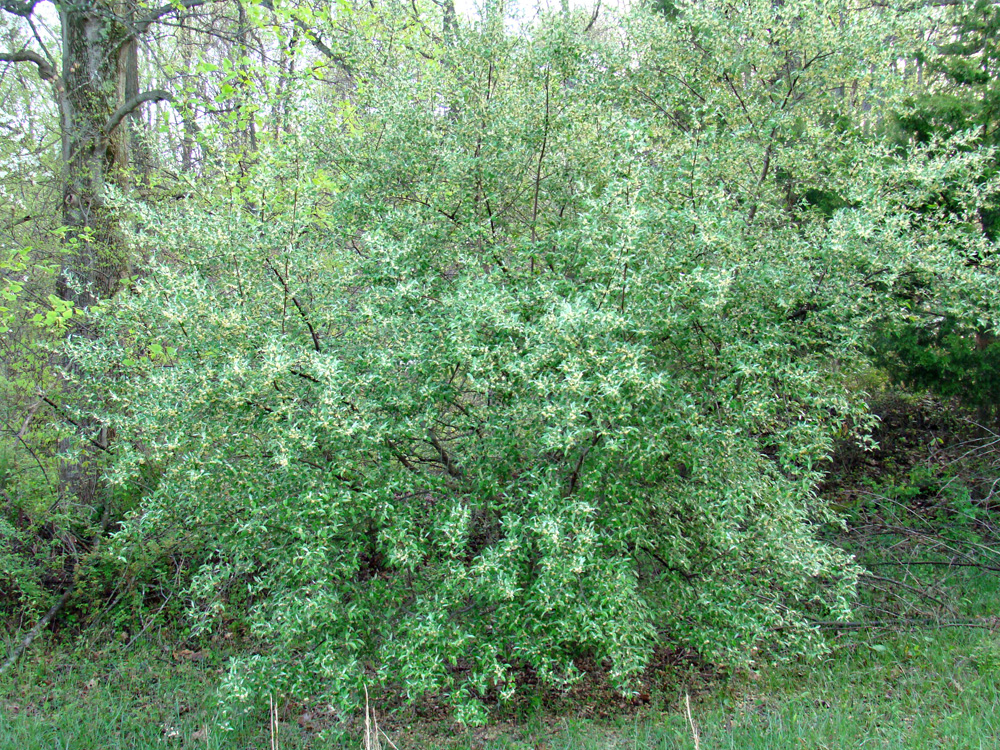
Elaeagnus umbellata shrub - 10 feet tall


Not long after we moved onto our place, after the cows had been gone a while, and after we stopped raising sheep, we noticed more and more little shrubs with silver leaves popping up.
Elaeagnus umbellata flowers - April

And they grew.


They bloom in the spring and the small white tubular flowers smell like warm spices from far away places.   I thought they were enchanting, so we left them. 

Elaeagnus umbellata berries
And then they bore fruit and I figured out what they were:  Elaeagnus umbellata. [Think of it like a woman's name:  Elly Agnes.]  The autumn olive.  

UPDATE:  Apparently sometimes these have nasty thorns.   I had no idea!  We have the thornless kind.  


And then we found out that they're considered a pest here.   Because the birds love them.   And eat them.  And poop their seeds everwhere.    And now we have loads and loads and loads of them. 
 
The red berries are small - about the size of the nail on your little finger - and have silver spots. 

I did a lot of searching to find out if the berries are edible and indeed they are.    They're very acidic and have a large seed.   If you taste one right off the tree, you'll get that weird dry taste that you get from green bananas and unripe persimmons.

They're abundant, they're full of vitamin C and they're free, so I set about experimenting to see what kind of jam I could make.

The first thing I learned was that the redder they are, the better they are.  Also, it's best to not skimp on the sugar.   These babies are tart, I tell you.   Treat them like cranberries - be generous with the sweetener.

I tried elaeagnus jam with a touch of lavender and lemon verbena - very nice, but not great.  No one would eat it but me.   Also, I had used pectin and that jelly was firm.

Really firm.   If only my butt were that firm.

Then this year, I tried it with oranges and no pectin and Hello! We have a winner!  This jam is good!  Everyone likes it.

And it's really pretty.   It looks as good as it tastes.

This is what I did:


Elaeagnus Orange Jam
from www.rurification.com

  • Pick about 4 cups of berries.  Make sure they're good and red. 
  • 1/2 cup water
  • 4 cups sugar
  • 2 oranges:  Zest and juice.


Wash the berries and put them in a pot with the water.  Cook until they're good and soft.   While they're hot, pour them into a chinois or strainer and mash the berries to get the juice and pulp out. 


Don't let the seeds fall into the juice and pulp.  [I don't try to squeeze them all dry.   Seeds are often bitter and I don't want that in the jam, so I stop straining when things start getting dry and sticky and most of the juice and pulp is out.]


Almost done!


Discard the seeds and skins. [Chickens like them.]  Put the pulp and juice back into the pot and add the sugar, orange zest and orange juice.   Cook until it boils hard.  


Ladle into jars.   Process for canning 10 minutes for pints and jelly jars. 

Related Posts Plugin for WordPress, Blogger...