Happy Halloween!
It's Spooky Day! I hope you have something wonderfully fun planned for this evening. We are going to snuggle up with a fun movie [The Ghost and Mr. Chicken] and a bowl full of chocolate.
In the grand Halloween tradition of the blog, I bring you another wonderful rural cemetery. This one is located between Freedom and Worthington, Indiana - off Highway 231 a few miles down Pleasant Bethel Rd.
It's across the street from an old white church and it's nestled between corn fields and woods. It's peaceful and beautiful there.
This year I noticed the wonderful types of carvings on the stones here. I loved the stylized carving on the granite stones.
The were several examples of art deco type carvings, like the corners of the John and Clara Nation stone.
The Mitten family area had many beautiful stones. I loved Ella Mitten's stone. Notice the anchor. According to this site, anchors are often used in places where sailing is common. That is not the case in southern Indiana, so it must mean something else. Anchors are also symbols for steadfastness and that is most likely the meaning here.
This is the stone of Gracie Mitten. Notice the gates on this stone and the stone above. These are the Pearly Gates - the gates of heaven. Open to allow the person in.
I loved the simple carving on John C. Mitten's stone. I saw the flower on several stones from the Mitten family.
This is the Colenbaugh stone. I think those are stylized weeping willows - or perhaps columns? - just above the names. I couldn't find any information on them.
I love finding stones like these. Notice Sarah's dates.
She was born Nov. 16, 1848, but she never died. A perfect Halloween grave! She'll be 166 years old in a couple of weeks.
And speaking of the undead. I found a couple more old stones with names of the undead.
Here is Josiah Trent's stone. He was born February 7, 1828. Apparently, he didn't die. He's 186 this year.
This is John Wesley Workman and Cristine C. Workman's stone. Cristine was born on my birthday [July 16] in 1835. No death date. I hope this means that July 16th is a lucky date and I'll rocking the country life forever. Or at least for 179 years or so.
Stacked log headstones are often markers of the graves of men who belonged to the Woodmen of the World fraternal organization. Those graves usually have an axe carved on them, too. I didn't find an axe on this marker, so I'm not sure if the stacked logs are symbolic or not.
This site has a lot of information about the WoW grave markers. See what you think.
And speaking of logs and wood, in almost every old cemetery out here, you'll find a marker like this one. A carved tree trunk with broken limbs. The symbolism is of a life cut short. The carvings are marvelous and painstaking.
This is Charles Dyer's stone. He died in 1893. He was 23 years old when he died. So sad.
Someone clearly loved and missed him very much.
There are ferns carved at the bottom of back of the tree and ivy climbing up and through the broken shield. There's a lily at the bottom in the front.
[But there's no axe.]
There is a verse carved in a curve on the shield, but it's so worn that I can't read it at all. Blow up the pic and do your best.
I hope you enjoyed this year's spooky cemetery tour. If you want more, then here are previous years' tours.
2013 - Tulip Cemetery
2012 - Solsberry Cemetery
2011 - Philpot Cemetery
Showing posts with label cemetery. Show all posts
Friday, October 31, 2014
Monday, March 10, 2014
Sol's Berry Farm
We live near a bump in the road called Solsberry. Most people assume that 'Solsberry' is a corruption of Salisbury, named after the city in Wiltshire, England, and that we dumb Hoosiers just couldn't spell.
They have a point - the town of Gnaw Bone, Indiana is indeed a corruption of the French name, Narbonne.
Hey. We don't speak French in Indiana.
Except maybe in French Lick. Which was named because a French trading post was set up near a salt lick. But probably, no one has spoken French there in a long time.
Except maybe the high school French class. And maybe those international students from IU who went to see the casino.
And my friend in Lafayette [which was named after a French guy].
At any rate, in our case, Solsberry was not named for Salisbury. It is named for Solomon Wilkerson.
You see, Sol took advantage of the plethora of wild berries around here and picked and sold them. People loved Ole Sol's berries.
Yep. You see where this is going, right?
Sol is memorialized in the Solsberry Cemetery, where you can see his original limestone gravestone [above] and where they've put this beautiful plaque telling his story. This is what the plaque says:
"Solomon Wilkerson 1800 - 1875.
Solomon Wilkerson founder of Solsberry, was born in North Carolina in 1800 and moved to Monroe County, Indiana, in 1820 where he married Polly Anderson in 1833. In 1835 they moved to Greene County, Indiana and erected the first house in what is now known as Solsberry.
In 1850 Solomon platted the site for Solsberry. It was divided into 34 lots, each of them being 66' x 132'. The streets were 66' wide and the alleys were 12' wide. The street running north and south was named Washington, and the street running east and west was named Main. Because the blackberries and blueberries were plentiful in the area, Solomon picked and sold them; hence the town was name for 'Ole Sol's berries'.
Solomon was held in high esteem, serving as Justice of the peace for several years. In 1875 he died after being thrown from a horse near Bateman Ford, on Richland Creek, northwest of Solsberry."
Here's a closer up pic of the original marker. It's a good thing it's protected - the limestone is melting away with time and exposure to the elements.
Sol has a facebook page, where you can go see a picture of him.
Here is an old map of Greene County from 1879, just 4 years after Sol died. See if you can find Bateman Ford on Richland Creek.
There's not much left of the town except an intersection and a cluster of houses. We have a post office and a fire station and Yoho General Store. [You ought to stop by Yoho and get some ice cream - it's tasty!] The folks who live here are super friendly so wave when you come to town. You'll get a smile and a long chat if you have the time.
They have a point - the town of Gnaw Bone, Indiana is indeed a corruption of the French name, Narbonne.
Hey. We don't speak French in Indiana.
Except maybe in French Lick. Which was named because a French trading post was set up near a salt lick. But probably, no one has spoken French there in a long time.
Except maybe the high school French class. And maybe those international students from IU who went to see the casino.
And my friend in Lafayette [which was named after a French guy].
At any rate, in our case, Solsberry was not named for Salisbury. It is named for Solomon Wilkerson.
You see, Sol took advantage of the plethora of wild berries around here and picked and sold them. People loved Ole Sol's berries.
Yep. You see where this is going, right?
Sol is memorialized in the Solsberry Cemetery, where you can see his original limestone gravestone [above] and where they've put this beautiful plaque telling his story. This is what the plaque says:
"Solomon Wilkerson 1800 - 1875. Solomon Wilkerson founder of Solsberry, was born in North Carolina in 1800 and moved to Monroe County, Indiana, in 1820 where he married Polly Anderson in 1833. In 1835 they moved to Greene County, Indiana and erected the first house in what is now known as Solsberry.
In 1850 Solomon platted the site for Solsberry. It was divided into 34 lots, each of them being 66' x 132'. The streets were 66' wide and the alleys were 12' wide. The street running north and south was named Washington, and the street running east and west was named Main. Because the blackberries and blueberries were plentiful in the area, Solomon picked and sold them; hence the town was name for 'Ole Sol's berries'.
Solomon was held in high esteem, serving as Justice of the peace for several years. In 1875 he died after being thrown from a horse near Bateman Ford, on Richland Creek, northwest of Solsberry."
Here's a closer up pic of the original marker. It's a good thing it's protected - the limestone is melting away with time and exposure to the elements.Sol has a facebook page, where you can go see a picture of him.
Here is an old map of Greene County from 1879, just 4 years after Sol died. See if you can find Bateman Ford on Richland Creek.
There's not much left of the town except an intersection and a cluster of houses. We have a post office and a fire station and Yoho General Store. [You ought to stop by Yoho and get some ice cream - it's tasty!] The folks who live here are super friendly so wave when you come to town. You'll get a smile and a long chat if you have the time.
Thursday, October 31, 2013
Tulip Cemetery
Happy Halloween! This year I'm taking you to the Tulip Cemetery. It's a classic old rural cemetery next to the old Tulip Church, which is just down the way from the new Tulip Church. The stones are tilted and tipped and we noticed that the rows of graves are definitely not straight. There's a lot of history here and we found some great stones.
Here is a link to the 2012 post about Solsberry Cemetery.
Here is a link to the 2011 post about Philpot Cemetery.
Tulip Cemetery is a cemetery that is mixed old and new and it's as full of interesting stories as the rest of our rural cemeteries. Here are a couple of the newer and very interesting stones.
This Helms stone lists the profession of the husband and wife. I loved this! [I forgot to get a pic of their names and dates for you.]
This stone for Allen Sarvis has his photo on it. I liked the whole photo thing, but it creeped my kids out.
I love his epitaph: He cared.
Lovely.

I was lucky enough to find several graves from old soldiers here. This was the oldest stone that I saw in the cemetery. George Sarver was born in 1787 and died in 1862. He was 75 when he died. He served in the War of 1812. How cool is that?
Next to him was his wife's grave.
Elizabeth Sarver was born in 1797 and died in 1879. She was 82 when she died.
This is Simpson Osborn's gravestone. He served in the Mexican War, 2nd Indiana Infantry, Company E. He was a private.
I found an amazing record of this regiment here. The men in this regiment were all from around here. It looks like Private Osborn did survive the Mexican War, but not much else is known about his service.

Way back on the edge of the grounds I found this grave in the brush, surrounded by honeysuckle and poison ivy and grapevines.
This is a Civil War veteran's grave.
This man is Robert E. Daily. He was a corporal in the 186th Ohio Infantry, Company G. You can see him here on page 13 of this pdf.
I want to know how he got to Ohio to enlist and then back to Indiana. Did he survive the war and then move here from Ohio?

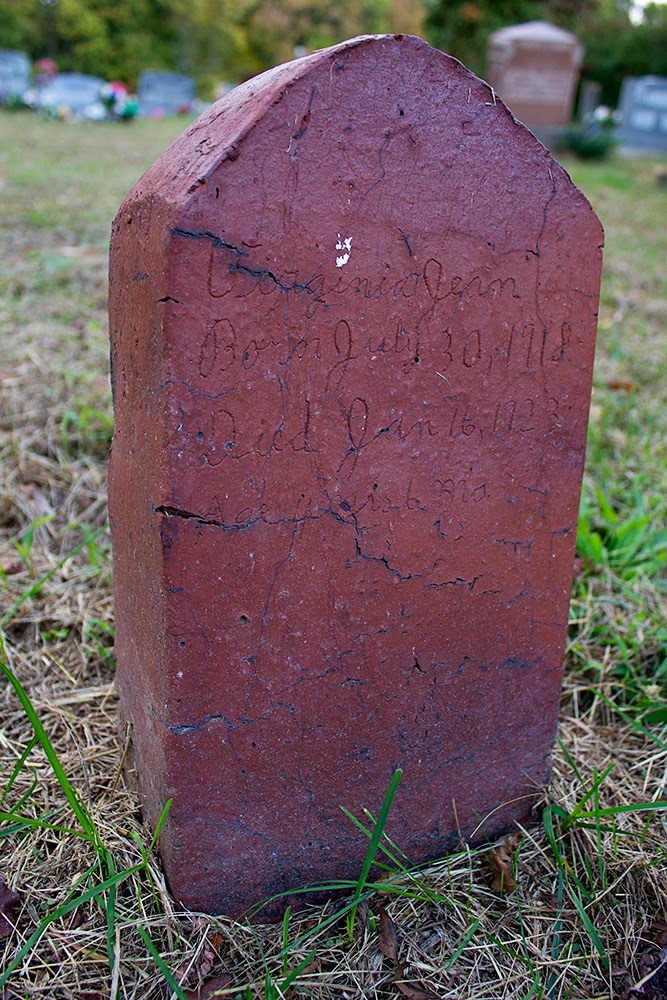
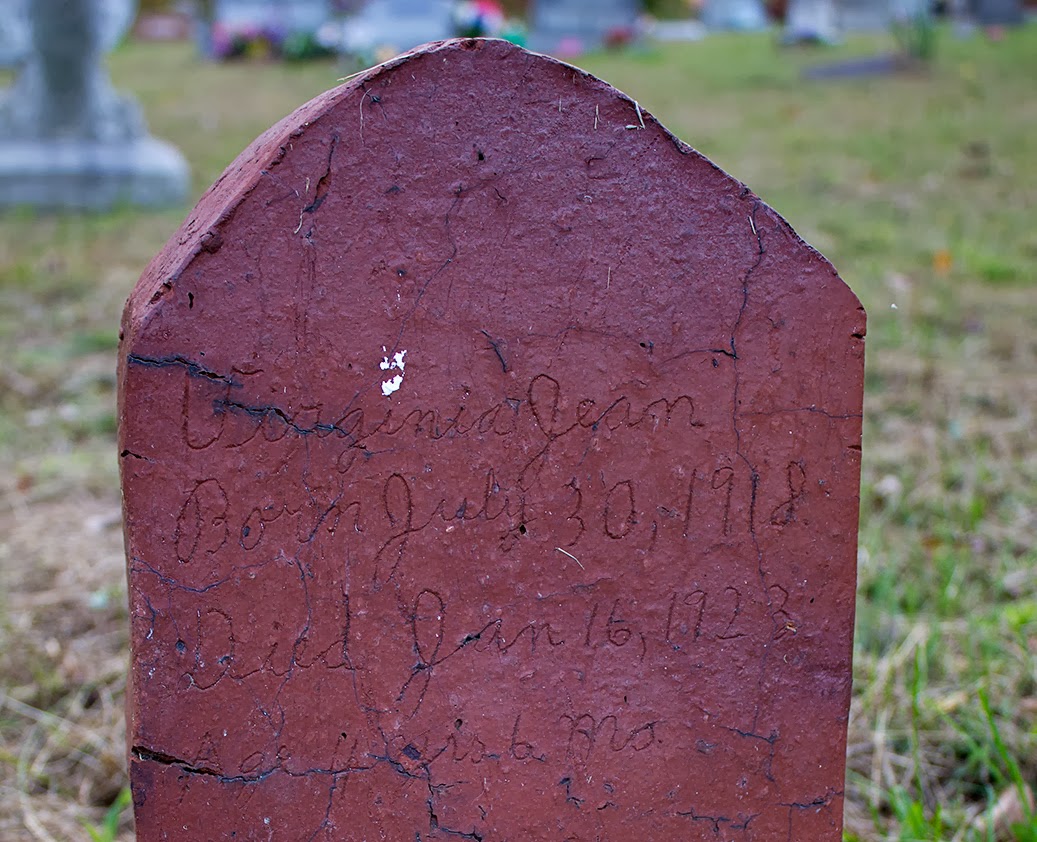
This was the most interesting stone in and of itself that I found. It's brick. The only one like it that I've seen. It's for a child. The letters were incised with a sharp instrument.
Did her father make it for her?
It says:
Virginia Jean
Born July 30, 1918
Died Jan 16, 1923
Age 4 yrs, 6 mo
These winter deaths - I wonder if it was the flu or another epidemic that took her.
This is the monument for Margret Bunch. Her epitaph reads:
Another cool epitaph was on Jacob Axe's headstone. We could read everything but one word in the middle. Tell us what you think it is.
Here is a link to the 2012 post about Solsberry Cemetery.
Here is a link to the 2011 post about Philpot Cemetery.
Tulip Cemetery is a cemetery that is mixed old and new and it's as full of interesting stories as the rest of our rural cemeteries. Here are a couple of the newer and very interesting stones. This Helms stone lists the profession of the husband and wife. I loved this! [I forgot to get a pic of their names and dates for you.]
This stone for Allen Sarvis has his photo on it. I liked the whole photo thing, but it creeped my kids out.
I love his epitaph: He cared.
Lovely.

I was lucky enough to find several graves from old soldiers here. This was the oldest stone that I saw in the cemetery. George Sarver was born in 1787 and died in 1862. He was 75 when he died. He served in the War of 1812. How cool is that?
Next to him was his wife's grave.
Elizabeth Sarver was born in 1797 and died in 1879. She was 82 when she died.
This is Simpson Osborn's gravestone. He served in the Mexican War, 2nd Indiana Infantry, Company E. He was a private.
I found an amazing record of this regiment here. The men in this regiment were all from around here. It looks like Private Osborn did survive the Mexican War, but not much else is known about his service.

Way back on the edge of the grounds I found this grave in the brush, surrounded by honeysuckle and poison ivy and grapevines.
This is a Civil War veteran's grave.
This man is Robert E. Daily. He was a corporal in the 186th Ohio Infantry, Company G. You can see him here on page 13 of this pdf.
I want to know how he got to Ohio to enlist and then back to Indiana. Did he survive the war and then move here from Ohio?

This was the most interesting stone in and of itself that I found. It's brick. The only one like it that I've seen. It's for a child. The letters were incised with a sharp instrument.
Did her father make it for her?
It says:
Virginia Jean
Born July 30, 1918
Died Jan 16, 1923
Age 4 yrs, 6 mo
These winter deaths - I wonder if it was the flu or another epidemic that took her.
This is the monument for Margret Bunch. Her epitaph reads:
Beneath this
stone I've
placed in trust
Not the
immortal but
the dust
of one on
earth to me
most dear
who learned in
youth her God
to fear.
Another cool epitaph was on Jacob Axe's headstone. We could read everything but one word in the middle. Tell us what you think it is.
An amiable father here lies at rest
As ever God with His wings blest
The friend of _______, the friend of truth
The friend of age, the guide of youth.
Martha Osburn's stone has all the Ns backward.
Kinda makes me wonder what was going on there.
This stone was right at the foot of a tree.
Which means, some squirrel planted something here at the base of the stone and the tree was allowed to grow up right next to the headstone for a lot of years. Too bad; it's a very interesting stone.
Emily A. McCullough
was born Jan 3 1884
died Oct 30, 1885
Did you notice the lines across the stone? Someone wanted to make sure those lines were written straight...ly.
Our very favorite stone of all is the most appropriate one for Halloween.
Almira Nidy was born January 1, 1846 and .....that's all.
She appears to be still alive.
Or perhaps just undead.
Labels:
cemetery,
halloween,
Tulip Indiana
Wednesday, October 31, 2012
Solsberry Cemetery
This is the sign on the road that leads to the Philpot Cemetery just down the way from us. I laugh every time I see it, and I've been saving this pic for today. Happy Halloween!
To celebrate this day of the dead, we went to another local cemetery, Solsberry Cemetery, just off Highway 43, north of Solsberry, Indiana. It's a wonderful old cemetery, still in use, with graves dating from the mid 1800s.
Pretty, isn't it!
Click the pic and check the bottom right of the stone for Mr. Sudbury's signature.
We found more interesting carving on the gravestone of John Cox. He was born January 3, 1821 and he died April 17, 1891. What changes he must have seen all around him during his life. He lived through the Civil War.
I love his epitaph, way down at the bottom: Farewell my wife and children all, from you a father Christ doth call.
I also love this gravestone because of the carving in the center. It's faint, but still visible.
Here was another gravestone that I loved. This is on the grave of 3 year old Nellie Torrence. She was born July 3, 1884 and she died August 2, 1887. Her epitaph is: Buried on earth to bloom in heaven.
So sweet. She is buried next to her sister Ruth, who died at 2 yrs old.
The most interesting stones we found were a couple of stones shaped and carved by hand out of the local creek rock. It's a miracle they've lasted all these years.
Here is the stone for L M Newton. No other information. What did L M die of? Who carved the stone? Were they too poor for a limestone marker? These graves are mixed in with the others, and not separated in another section as if they were in the pauper's part of the cemetery.
This is the gravestone of Hannah May. Her name is misspelled on the stone: Hannh May. She was born Jan 25, 1817. She died Sept 6, 1855.
Labels:
cemetery,
gravestones,
halloween,
solsberry
Monday, October 31, 2011
Philpot Cemetery
Not far up our road is Philpot Cemetery. I love cemeteries. Old ones, new ones, well kept ones, abandoned ones.
They're peaceful. And quiet.
And full of stories.
And full of dead people. People who once lived here, maybe on my farm. People who were children and then grew up and had children. People who laughed and argued and danced and went to church. People pretty much like us only they lived without computers.
And electricity.
And bathrooms.
Boy, am I glad I live now and not then.
Philpot is a Civil War era cemetery and a few of the men buried there served in the Civil War so their graves are marked with the units they served in. Some good soul puts flags on those graves for Veteran's Day.
Take the Miller family. Jane and Alex Miller had two daughters that died young-ish. Mahala Miller was born in 1850. Genevra A.Miller was born in 1855. Jane, the mother, died in June of 1867 and Mahala died in November of that year. She was 17. Genevra was only 12 years old when her mother and sister died. She died just a few years later in 1874 - at only 19 years old. I wonder if Jane and Alex had other children and what happened to them. Alex served in the Civil War, but only his military marker is still there. The headstone with the dates is gone. [Other men had two headstones, one with the family information and one with the military information.] Did he live through the war? Was he back home when his wife and daughter died?
The Gaston family must have been wealthy. They had monuments for headstones. They are wonderful monuments with beautiful carving and often had names and dates for more than one person on a stone, one per side.
All of the markers in the cemetery except one are made of limestone. Not surprising here in southern Indiana. The only non-limestone marker is granite - the one on the right in the pic above. The date on that stone is 1907. That is the latest year recorded in the cemetery.
The center stone in this pic belongs to Margaret Lyons. She lived from 1834-1853. She was 19. Her epitaph reads:
Remember friend as you pass by
As you are now, so once was I
As I am now, so you must be
Prepare for death and follow me.
It really does say that.
Happy Halloween!
Labels:
cemetery,
graves,
headstones,
philpot
Subscribe to:
Posts (Atom)