Showing posts with label landscapes. Show all posts

Saturday, December 19, 2020

Course Review - Ian Roberts' 'Brushwork & Color' Course


Earlier this month, I finished a Brushwork & Color painting class with Ian Roberts.  It was transformational.

There were a few challenges:

  • Ian is an oil painter and all the demos were in oil.  I am a watercolorist, not interested in working with oil.
  • We had a specific set of primaries to use.
  • I am an inveterate comparer of my work to others'.  This does not go well for me. 
  • I wanted to stay caught up despite a number of other things going on:  big house projects, kids dealing with covid & college/job stresses, my own job, etc. 

Some of my aha! moments:
  • A good Standard Operating Procedure will get you a decent painting regardless of whether you're having a bad day or a bad attitude.  Follow the SOP.  
  • Green in bright sunlight can be represented by a number of colors that aren't actually very green.
  • Start by thinking about the focal area; let the rest fall into place after that.
  • You can't ignore backgrounds.
  • Sometimes the 6th version is when you get it.
  • Value studies are very enjoyable.  I don't need an excuse to do them.   [I feel a series of value studies in purple coming on....]
  • I'm better at still life than I think I am.
  • It is perfectly acceptable to mix all the colors I need to get a color/effect, despite the watercolor 'rule' to never mix more than 2 or 3. 
  • Purple vines are freaking awesome. [I already knew that.]
  • Evening light goes really pink.
  • I know my watercolor pigments well and have an excellent grounding in color theory.  I can trust my choices in primaries that are appropriate for watercolor. 
  • It is possible to paint flowers in large simple masses and have it work
  • Consider everyone's piece on its own merit, not on how closely it matches the ref photo.  Look for the genius in their work.
  • Goal:  Sing the song on the paper, with gusto, my way.   It doesn't matter how everyone else is painting the same scene.
Now that the course is over, I'm formulating my goal for the next few months.  It will probably have something to do with working through my own reference photos and seeing if some of the bad ones can be salvaged.  [Seriously,  Ian had us working with nothing but greeeeeeen ref photos that had good bones, and showed us ways of tweaking them to make them really interesting.  I am sure I can find ways to do that with my own ref photos.]


    Here is some of my work from the course: 

    Value Study

    Muting Color: Still Life with Squash

    Muting Color Exercise 2

    Limited Palette: Purple/Blue instead of greens.

    Painting Light 1

    Painting Light 2

    Poppy Field

    Daisies


    Saturday, July 25, 2020

    Five Haybales: Afternoon


    © Robin Edmundson, 'Five Haybales, Afternoon', watercolor, 10 x 14 inches.   $375.


    Another in the 'Five Haybales' series.   This was the original 'light' intended for the composition.   I'm kind of loving those puffy afternoon clouds.  


    Thursday, July 23, 2020

    Five Bales: A series


    © Robin Edmundson, 'Five Bales, Dawn', watercolor, 10 x 14 inches.  $375.


    Once in a while, I explore the same composition a bunch of times with different colors, different lights.  Working in a series with a strong composition lets me focus on other things than the shapes and composition; it frees me up to explore a lot of other things.  

    In this series, I painted these five haybales in different light/times of day.  It was a lot of fun.  Over the next few days, I'll show you my favorites.

    This first one started out with a 'What if I started with a wash of neutral gray?'   It quickly developed into a sunrise/dawn scene and I just went with it.  I walk at sunrise a lot in the summer and the light is very familiar to me.  

    Sunday, January 12, 2020

    Studying Composition

    Studying Richard McKinley's book:  'The Landscape Paintings of Richard McKinley'

    Every serious artist that I know spends time looking at other artists' work, studying technique, composition and design and trying new things.   Lately, I've undertaken a study of composition, based on what I've learned from Ian Roberts' book 'Mastering Composition'.  It's one of my all time favorite art instruction books and I keep coming back to it. 

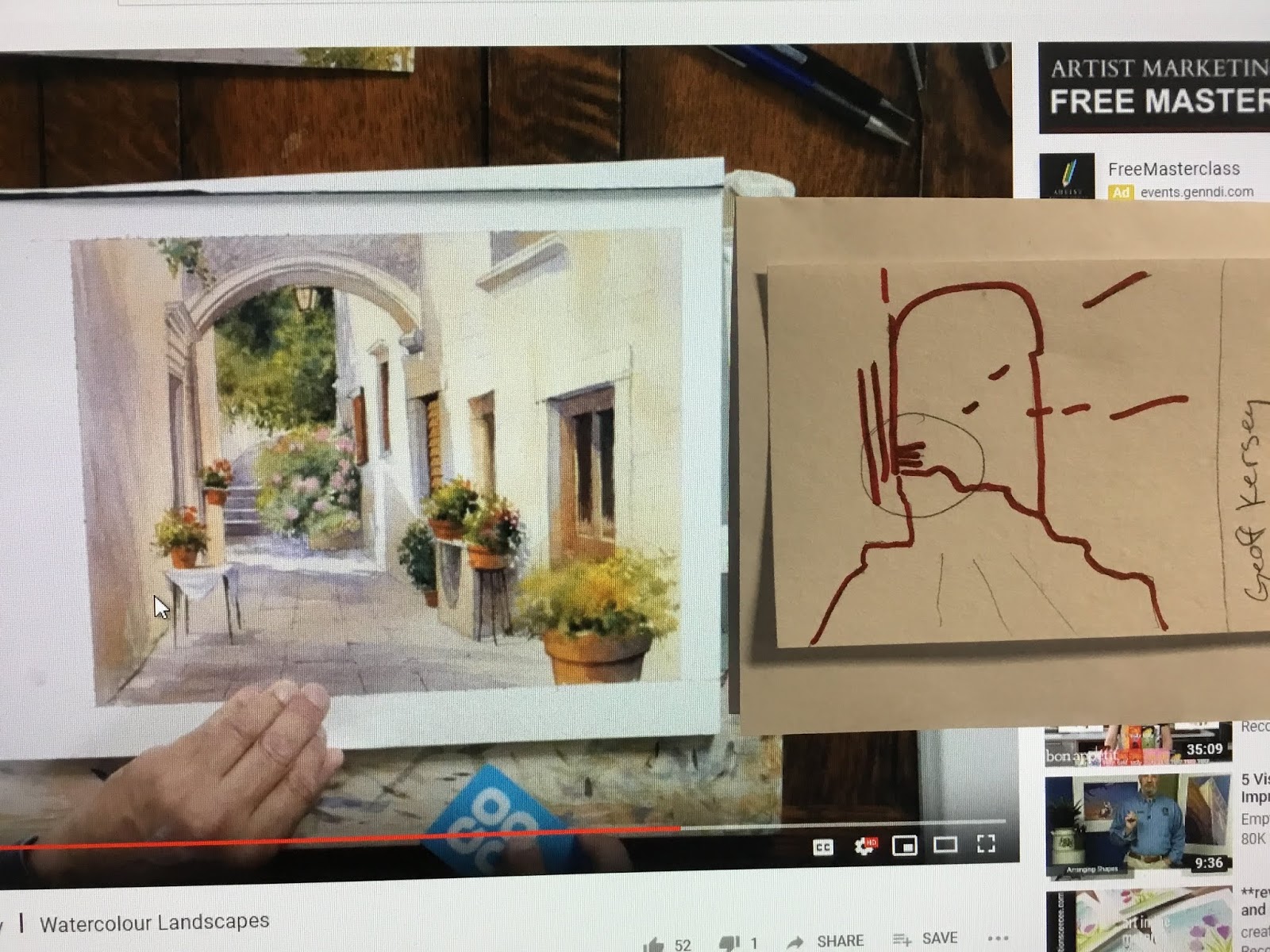
    One of Ian's suggestions is to study a piece and do a little composition sketch of what's going on in it.  I've been studying dozens of artists and looking at hundreds of paintings, doing these little sketches of the paintings I like best. 

    In the pic above you can see my little sketch of a piece by Richard McKinley in red sharpie on the top left.   This page also happened to give Richard's own working sketches as well. 

    As I do this, over and over and over, to paintings that are pleasing to me, I am seeing patterns that help me think about my own work.  Since I am able to abstract a visual pattern, I can then plug in the subjects that I am interested in painting, knowing that the structure under the whole thing is a visually pleasing one.

    Here's an example of how I use these.   This is a painting by Geoff Kersey.   My sketch is to the right [red sharpie]. 

    painting:  Geoff Kersey


    I can take that same basic structure and put my own spin on it, like I did in this practice piece I did for #paintrainforAustralia [Instagram]. 

    © Robin Edmundson, 'Paint Rain for Australia',  9 x 12 inches. 


    I'm hoping that this intensive study of composition will allow me to really internalize this skill so that it is unconscious. If I'm not worrying about composition, then I can focus on technique or color or subject or something else. 

    What new skill have you been studying lately?

    Sunday, May 28, 2017

    Double Trees - An exercise in correction

    © Robin Edmundson, 'Double trees', watercolor on paper, 9 x 14 inches.

    I started this piece a few weeks ago just playing around with a composition of two sets of two trees.  I liked the trees, parts of the sky and some of the colors.  Then I set it aside because I really didn't like the foreground.

    Then I took Sue Webb Tregay's 'Master Disaster' workshop in Indianapolis, which taught all the techniques in her fabulous book.   I came back and pulled this painting out and went to work.

    I loved the trees the most, so I cropped out some of the sky to make the trees a better focus for the piece.  

    The purple in the foreground had been MUCH stronger, so I took a lot of it out and  also some of the French ultramarine along the background fields.  

    The bottom had been a weak gold, and I loved the stronger gold in the trees, so I layered on more of the strong gold in the bottom foreground.

    It's a much better piece now and I'll be happy to hang it.
    Related Posts Plugin for WordPress, Blogger...