Showing posts with label goose pond. Show all posts

Sunday, June 2, 2019

Upcoming Show!

© Robin Edmundson, 'Goose Pond - 535', watercolor, 9 x 12 inches.  $375 [matted and framed to 16 x 20 inches]

Here is another of my recent pieces of Goose Pond.  They will be on view from June 15 - July 12 at the Gaslight Art Colony in Marshall, Illinois.

Opening reception is Saturday, June 15 from 5-8pm

If you'd like a postcard of the event, email me with your street address and I'll make sure you get one.

Thursday, May 23, 2019

Rain Makes Green

©Robin Edmundson, 'Rain Makes Green - Goose Pond', watercolor, 18 x 24 inches.
Framed and matted to 24 x 30 inches.  $750.

We had a wet spring. 

A very wet spring.

Here's the thing though:  It's kind of magical to watch the clouds gather, the sky darken and those sheets of rain move in from across the flats and lowlands. 

The wetlands soak it up [It's what they do best] and things turn a gentle green.

Sunday, May 19, 2019

Spirit of Place, Again

© Robin Edmundson, 'Goose Pond - 530', watercolor, 10 x 14 inches.  $375
[Matted and framed to 16 x 20 inches]

Another view of the marshes from the photos I took on our anniversary.  I'm kind of loving the movement of the grasses here.

Friday, May 17, 2019

Goose Pond

© Robin Edmundson, 'Goose Pond - 531', watercolor, 18 x 24 inches.  $750
[Matted and framed to 25 x 31 inches]

As I've worked with this reference photo and explored the spirit of this place, I decided to work bigger and tried this piece on an 18 x 24 inch block.  It helped me get a bit more personal with the marsh grasses. 

Sunday, May 12, 2019

Spirit of Place

© Robin Edmundson, 'Goose Pond - 529', watercolor, 9 x 12 inches.  $375
[Matted and framed to 16 x 20 inches]

On our anniversary in March, I took a bunch of photos of that blustery day at Goose Pond and Beehunter Marsh to use as reference photos for future paintings.

One in particular keep calling me.  It was nothing special - dark rainy clouds, rain obscuring part of the distant trees, a sweep of wet golden grassland.

It took a few weeks to start painting it, but now I can't stop.

I realized that I wasn't responding to the rain or the grass, but rather the spirit of the place.  The wild and windy spirit of that day.  The crazy weather, the birds, frogs, wind, water, snakes, bugs, clouds, sudden blue skies, then more lashing rain.   All of it.   I love all of it.  I can't stop painting it.

Friday, February 23, 2018

Goose Pond, February Fields - Plein Air

© Robin Edmundson, 'Goose Pond, February Fields - Plein Air', watercolor, 9 x 12 inches.


I went to Goose Pond again a few days ago and was so happy that the sun was shining this time.  Also, there were thousands and thousands of sandhill cranes that kept flying over.   I love that.   

My goal for these plein air sessions is to be able to focus enough to quickly find a composition from the vast landscape, get the drawing and painting going and to finish within 2 1/2 hours.   I did this one in under 2 hours and am pretty happy with the composition.   Practice, practice, practice!

Thursday, February 15, 2018

Goose Pond, Ducks - Plein Air

© Robin Edmundson, 'Goose Pond, Ducks - plein air', watercolor, 9 x 12 inches. 

At the beginning of the month, I spent another wonderful morning painting the view of the marshes from the visitors center at Goose Pond. Things are starting to rev up for the season. I could hear thousands of cranes, geese and ducks. This is the view toward the north. There was quite a bit more water in the ponds this time and the ducks were taking full advantage. I saw hundreds flying in and around these few ponds.

Monday, January 22, 2018

Plein Air


I've found a lovely place to do some plein air work this year.   The Goose Pond Visitors Center in Linton, Indiana has a beautiful perch on the top of a hill with great views on three sides.  Plenty of windows so I can paint in shelter and warm for the rest of the winter.   I'm hoping to get over there a couple of times a month.

While I was painting this, the rain rolled in and several flocks of geese and cranes flew over.   It's a wonderful place.   I'm excited to make this a regular part of my painting routine.

Sunday, November 26, 2017

Goose Pond


Recently, I was thinking about the things that make me happy.  Someone suggested doing a Mind Map  of them - an activity I found very useful for figuring some things out.  I had a whole section of things that lift my spirits.

Goose Pond [and Beehunter Marsh] is one of them.  I love the birding, I love the views, I love the farmland.  It never disappoints.  On Thanksgiving, while the turkey was roasting, we took a drive over there.  Above is one of the views from the new visitor center.   I love these views.

We wound around the hundreds of acres of fields, pools and ponds and right off the bat, we found a bald eagle enjoying his dinner atop a muskrat mound.   He was completely unfazed by the large crow that was flying around close by.

On the drive, we were lucky enough to see 8 whooping cranes.   8 years ago, this was unheard of, but Greene County has been attracting more migratory birds and we were so excited to come upon a feeding pair in a field, then another pair in an other field and then 2 more pairs in a third area. 

We saw hawks, harriers and loads of ducks and even a pair of trumpeter swans - and they were in a pool that was close to the road so we could get a good pic.


So thankful we live near this place.   It makes me want to be a better steward of the property we have. 

Saturday, April 30, 2016

American Bittern

This is an American Bittern.   We saw her at the edge of one of the back roads on Goose Pond SWR this week.  She posed quite nicely for me to snap a couple of pics.  

Mostly I was there to take pics of the marsh, but the place never disappoints.  It's a feast of sound and light and even on overcast days like this one, it's beautiful.    We're still trying to identify some distinctive bird songs we heard. [Edited:  Turns out it was a bunch of common snipe.  Spooky.] Spring is a great time to visit.


Here's another view of the bittern.

The marshes are beautiful this year.   Lots of water and lots of birds.  Everything is greening up fast.

We saw a lot of Canada geese and coots, a couple of northern shovelers [so pretty!], an otter, some blue winged teals and assorted lots of other birds we didn't take time to identify.

Thursday, April 24, 2014

Goose Pond in April

It's no wonder the ducks and cranes and pelicans love this place.  Those open expanses of shining water and grass are enchanting.   It's pretty in the morning mist.

Thursday, April 17, 2014

Pelicans at Goose Pond


Goose Pond NWR is not far from us and we like to pop over every once in a while to see what new birds we can see.      We love our water birds, so we were excited to see these guys last weekend.   They are American white pelicans.     So beautiful in flight.      Claire snapped this pic as they flew from one pond to another.

Gorgeous.

Here's another pic of some pelicans.   The day we were here, they counted a flock of 1500 pelicans.   That is the largest number of pelicans ever for Indiana.  They were first recorded in Indiana in 1887, so this isn't their first time here, but until 2004, the number stayed below 52.   Then BAM, they re-discovered the midwest and the numbers have been climbing ever since. 


We also saw some northern shovelers.   Apparently it's been a spectacular year for ducks, too, at Goose Pond.  


Here's the Friends of Goose Pond site, if you are interested in what else goes on out here.

Thursday, July 5, 2012

Black Necked Stilt

Beehunter Marsh, Indiana
On Father's Day weekend, we took a little drive out to Goose Pond and Beehunter Marsh to do a little birdwatching. 

It's a real test of a bird sanctuary to see what cool birds are around in the middle of the day in the middle of June on a 90 degree day.  

A real test of the people silly enough to try it, too.  

Our expectations for bird watching were low. 

Beehunter was quiet.  We didn't walk far enough to where we'd seen the bald eagle before, but we did see some geese.

The girls said that geese were boring.    K2 wanted ducks.   You know how she loves her ducks.

Lily was only going to be impressed by something spectacular, like the whooping cranes we saw there a couple of years ago. 

So we got back in the car and drove on to Goose Pond. 
Egrets and great blue heron, Goose Pond, Indiana


Goose Pond is so wet now that it's full of water now, even after all those 90 degree days with no rain.  

That's the power of clay. 

We pulled off Hwy 59, to watch for birds.  

Herons
We saw a lot of egrets and a lot of herons.

A. Lot.  

And we kept seeing a smaller bird flying around that was black with a big white tail.    We were patient and finally saw some wading and close enough to photograph.

Black necked stilt and egret, 6/17/2012, Goose Pond, Indiana
That little black and white bird on the left near the white egret is a black necked stilt.

Black necked stilta are pretty common - on the other side of the Mississippi River.

As in,  woo-hoo!  This is a spectacular bird sighting.   Very rare for Indiana.

In the middle of the day.

In the middle of June.

When it's 90 degrees outside. 

And a stiff breeze is blowing.

We'd never seen anything like it and had forgotten the bird books [of course!], so we had to look it up when we got home that evening.  

Lily figured out what it was and she was, indeed, impressed. 
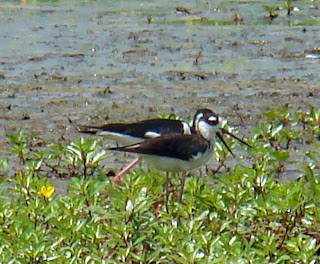
Black necked stilt, 6/17/2012, Goose Pond, Indiana
So were the rest of us. 

I can definitely recommend Goose Pond NWR as a fabulous birding site, even at the most unlikely times and seasons.    You never know what you're going to see there. 

Egrets and black necked stilt, 6/17/2012, Goose Pond, Indiana

Tuesday, July 3, 2012

Goose Pond and Beehunter Marsh

Egrets and great blue herons at Goose Pond, Indiana
Not far from us is one of the most amazing wetlands in the midwest.   Goose Pond and Beehunter Marsh sit almost adjacent to each other.  A few years ago they were reclaimed from agricultural use and purchased as a National Wildlife Refuge.   This is what the website says:
The soil in much of the basin has a clay content exceeding 70 percent, which greatly restricts subsurface drainage. The cropland was tiled and drained with lateral surface drains that emptied into an extensive ditch system. The open ditches conveyed runoff waters to pump stations where the water was pumped over the levees into the ditched creeks. Since it is a natural basin with low, level topography and tight subsoil, flooding was a constant agricultural concern that required constant maintenance of the drainage systems. This drainage problem was likely the reason for a large portion of the area changing ownership eleven times in approximately 35 years. Both Federal and State agencies had considered the area for acquisition and restoration at various times since the early 1950s.
Geese at Beehunter Marsh, Indiana
I totally understand the clay thing.   Really.

Clay is a pain.

These wetlands are what is left of the Blackwater Marsh, a glacial era wetland.   It almost disappeared.  This is how much they've restored so far:
Wetland areas:
Beehunter Marsh: 541 acres
Goose Pond Main Pool East: 320 acres

Goose Pond Main Pool West: 1,223 acres
Goose Pond (other units): 1,876 acres 
Total Acreage: 3,960 acres of open shallow water
There have also been more than 400 acres of tree plantings and more than 1,300 acres of native prairie grass plantings so far.
I haven't figured out what these are, but the marshes are covered with them.
 Here is more info on the plantings:
Prairies were restored on approximately 1300 acres of upland soil types and consist primarily of native prairie grasses and forbs (wildflowers). Species include big bluestem, little bluestem, Indian grass, prairie cordgrass, prairie dock, blazing star, and black-eyed susan. These habitats will provide excellent nesting habitat for waterfowl as well as grassland birds. Prairies also provide winter cover and foraging habitat for several grassland species that have shown population declines in recent decades, including short-eared owls, dickcissels, upland sandpipers, sedge wrens, and Henslow's sparrows.
Bottomland hardwood trees (including oaks and hickories) have been restored on approximately 300 acres. Once this forest community matures, it will likely become inhabited by squirrels, turkey, white-tailed deer, and many species of resident and migratory songbirds.
Approximately 75 acres of oak savanna will be restored. The historic data appear to indicate that oak savanna may also have been a component of the uplands surrounding the Beehunter Marsh. Midwestern oak savannas are among the rarest ecosystems in the world, with less than one percent of Indiana's original savanna remaining. Savannas are much like prairie habitats in that fire tolerant species comprise the majority of the vegetation. Unlike prairies, however, savannas, or oak barrens, do have a woody plant component generally represented by bur and/or black oak. The oak trees will be planted sparsely, approximately 27 to 48 trees per acre. Although many species of plants are common to both savannas and prairies, the animal communities will be slightly different due to the structural component the trees add. Prairie warblers, indigo buntings, red-headed woodpeckers, and loggerhead shrikes are just a few of the species which benefit from this type of habitat.
Herons and egret, Goose Pond, Indiana
I found some other really interesting photos, here.

And here is a map of the property.

Egrets and black necked stilt, 6/17/2012,  Goose Pond, Indiana

Related Posts Plugin for WordPress, Blogger...