Showing posts with label wild flowers. Show all posts
Saturday, May 6, 2017
Cynoglossum virginiana - Hound's Tongue
I have spent a lot of time in my life searching the woods and fields for plants, trees, etc. and learning how to identify them. It's my way of getting to know the neighbors.
I thought I knew all the wildflowers along the road and then this week, I saw this little gem in the woods 15 feet inside the treeline. Turns out there was a nice little colony of them. I don't know if they're new to the neighborhood, or just new to me.
At any rate, meet Cynoglossum virginiana, also called Wild Comfrey and Hound's Tongue.
Here's the thing though. It's definitely not a comfrey, which is Symphytum officinale.
Cynoglossum has fuzzy leaves like comfrey, but flowers more like a forget-me-not or borage.
The flowers have five petals and here they are a mix of blue and purple.
I saw references to them as medicinal plants and others as poisonous plants. Before you ingest any, make sure you do your research.
I look forward to getting to know this plant better and to seeing if I find it in other places, now that I know what I'm looking at.
Thursday, May 14, 2015
White Violets
This was a good year for violets. They bloom at slightly different times. The weather was perfect for the white ones in the woods down the way this year.
Labels:
violets,
white violet,
wild flowers,
wildflowers
Sunday, April 26, 2015
....and Toad Trillium Blooming
This is a toad trillium in full bloom. It is a striking flower - mottled trio of leaves and a burgundy trio of petals above. So pretty.
Last year around this time we heard wood frogs quacking and barking but this year not a single one. Every year is different.
Labels:
spring,
toad trillium,
wild flowers,
wildflower
Saturday, April 25, 2015
Toad Trillium Bud
The weather has been so slow to warm up that we've seen the toad trillium buds this year.
Slow is good.
Labels:
bud,
toad trillium,
wild flowers,
wildflowers
Sunday, April 27, 2014
Trout Lilies
We have huge colonies of these around here. They are trout lilies - Erythronium americanum. Thousands and thousands of leaves carpeting the floor of the woods - but relatively few blooms. They are also called Dog Tooth Violets, because their bulb resembles the tooth of a dog.
We get excited to see them flowering, and they are actually really interesting wildflowers.
The wiki page says that they can grow in large colonies up to 300 years old.
According to this page at ediblewildfood.com, they are both medicinal and edible. The leaves can be eaten as a salad green, but not in large quantities. They have a symbiotic relationship with ants. They grow mostly from runners rather than seed dispersal.
Here's the page from the Lady Bird Johnson wildflower site. Note: their picture is wrong because true trout lilies have only one pair of leaves and one flower per plant. I don't know what variety their picture is of - unless someone picked a bouquet and photoed that.
We get excited to see them flowering, and they are actually really interesting wildflowers.
The wiki page says that they can grow in large colonies up to 300 years old.
According to this page at ediblewildfood.com, they are both medicinal and edible. The leaves can be eaten as a salad green, but not in large quantities. They have a symbiotic relationship with ants. They grow mostly from runners rather than seed dispersal.
Here's the page from the Lady Bird Johnson wildflower site. Note: their picture is wrong because true trout lilies have only one pair of leaves and one flower per plant. I don't know what variety their picture is of - unless someone picked a bouquet and photoed that.
Friday, September 6, 2013
Jewelweed
The orange jewelweed is blooming. It's freckled and speckled and screaming orange against the dark green leaves. It's an annual around here, but spreads easily and blooms profusely from late July until frost. It's an Impatiens - like the ubiquitous pink, white and red ones you find at the beginning of the season in every garden center. These are so much more interesting.They're about the size of the tip of your thumb to the first knuckle. Here's a pic of the side of one with the bud of a second just above it.
You can use the sap to treat poison ivy. Just crush the stems and apply it to the affected area.
I just recently read where someone is using jewelweed to seal a pond. Follow the links in the piece to the full story - it's really interesting.
Labels:
jewelweed,
orange,
wild flowers,
wildflowers
Thursday, August 22, 2013
Small Wood Sunflower
Beginning in late July, we see these pop up in the woods. They're taller than black eyed Susans and they have a yellow center instead of a brown one. They're long and loose and lanky and love the woods. They are definitely a moist shade loving plant.

They are the Small Wood Sunflower. It is indeed ironic that a shade plant would be called sunflower, but there you have it. They are Helianthus microcephalus.
On this one is a little metallic green bee in the Halictinae genus - same one as the sweat bee. I thought it was pretty.

They are the Small Wood Sunflower. It is indeed ironic that a shade plant would be called sunflower, but there you have it. They are Helianthus microcephalus.
On this one is a little metallic green bee in the Halictinae genus - same one as the sweat bee. I thought it was pretty.
Tuesday, August 20, 2013
Eupatorium or Eutrochium?
This is a colony of Joe Pye Weed. It's tall - about 8' tall. The flowers are varying shades of mauve.
This one is just ready to open but gives you a good idea of the color. When fully open it looks quite fuzzy and the bees and butterflies and hummingbirds are all over it.
This is one of many Eupatorium varieties we have here - tall ones, short ones, white, pink, blue...we have a bunch. Or it's a type of Eutrochium - hard to tell. I've seen almost identical photos in descriptions of both.
The leaves are opposite and 5 or 6 of them surround the stem. Sometimes the stems are spotted and the flower heads a bit flatter [Spotted Joe Pye Weed.] It likes moist areas around creeks and bogs. We have a lot of it along the creeks.
This one is just ready to open but gives you a good idea of the color. When fully open it looks quite fuzzy and the bees and butterflies and hummingbirds are all over it.
This is one of many Eupatorium varieties we have here - tall ones, short ones, white, pink, blue...we have a bunch. Or it's a type of Eutrochium - hard to tell. I've seen almost identical photos in descriptions of both.
The leaves are opposite and 5 or 6 of them surround the stem. Sometimes the stems are spotted and the flower heads a bit flatter [Spotted Joe Pye Weed.] It likes moist areas around creeks and bogs. We have a lot of it along the creeks.
Monday, August 19, 2013
Indian Pipe
This is Indian Pipe. It's one of our more unusual wildflowers - also called Corpse Plant.
Cheery, huh?
The Latin is Monotropa uniflora. [Or possibly it's Monotropastrum humile] It has no chlorophyll and instead feeds off of certain fungi, which in turn feed off decaying woods, especially beech. In the extra damp this year, we had several clusters pop up down near the bench near the creek where it is cool and green and shady all summer.
The clusters showed up especially where fallen branches had been decomposing.
Ghostly.
I can see why it's called Corpse Plant. Here's some more fun information about it. It's in the blueberry family....
Saturday, August 17, 2013
Hoary Mountain Mint
We have no mountains here, so this is perhaps a strange thing to find here, but it's native and it's happy, mountains or not. The plants have square stems as mints do and they get about 3 feet tall here. We see it every year along the roadsides, but t's all over the place this year, so clearly it likes the cooler, wetter weather. Even in all our clay.
The Latin is Pycnanthemum incanum. 'Pycnanthemum' means 'dense flower cluster' in Greek. Now you know. Saturday, April 20, 2013
Dead Nettle
This is one of the first things to bloom in the spring. It stays low to the ground and the cooler it is the darker the tops.
It perseveres through the inconsistencies of early spring. I love the color.
The Latin is Lamium purpureum. Here's the wiki.
It's called dead nettle because it isn't a stinging nettle. They're not even in the same family. Apparently it looks sort of nettle-ish and that's why it's called dead nettle.
Turns out that it produces some nectar and good pollen so it's a good source of early pollen for the bees. The pollen is red. [I'll be on the lookout to get a pic or two of it!]
It perseveres through the inconsistencies of early spring. I love the color.
The Latin is Lamium purpureum. Here's the wiki.
It's called dead nettle because it isn't a stinging nettle. They're not even in the same family. Apparently it looks sort of nettle-ish and that's why it's called dead nettle.
Turns out that it produces some nectar and good pollen so it's a good source of early pollen for the bees. The pollen is red. [I'll be on the lookout to get a pic or two of it!]
Labels:
dead nettle,
lamium,
nettle,
wild flowers,
wildflowers
Friday, February 15, 2013
Common Mullein
Its formal name is Verbascum thapsus. It's a transplant from Europe, brought over for its healing powers.
It pops up everywhere out here. We find it along the roadsides, creeksides, barn sides, and even on the rocks where a bit of dirt might gather. It's not fussy. It's tough and grows in the most unlikely places.
2000 years ago, Dioscorides recommended the plant as a curative for lung problems - coughs, colds and bronchitis. It has been included in many official and national formularies.
Bigger plants stay green all winter here - a lovely sight in January when everything else is brown. I love the silvery green.
The flowering stalk gets about 5 feet tall and has small yellow flowers along it. Rumor has it that the flowers are good as a natural dye. I've never used it, since collecting them would be tedious and it would take a long time to get enough to dye much at all.
It pops up everywhere out here. We find it along the roadsides, creeksides, barn sides, and even on the rocks where a bit of dirt might gather. It's not fussy. It's tough and grows in the most unlikely places.
2000 years ago, Dioscorides recommended the plant as a curative for lung problems - coughs, colds and bronchitis. It has been included in many official and national formularies.
Bigger plants stay green all winter here - a lovely sight in January when everything else is brown. I love the silvery green. The flowering stalk gets about 5 feet tall and has small yellow flowers along it. Rumor has it that the flowers are good as a natural dye. I've never used it, since collecting them would be tedious and it would take a long time to get enough to dye much at all.
Sunday, July 15, 2012
Tall Bellflower
This is Tall Bellflower: Campanula americana.
It's wild around here and pops up everywhere, especially in the shaded edges of the woods and roadsides.
An interesting thing about this plant is that it is both annual and biennial. The wiki has details. [Link above]
Down the way from us is a large stand and it is spectacular when it's all blooming at once.
It is indeed tall - most of the plants get around 48 inches tall, even when the year is dry.
Tuesday, July 10, 2012
Scullcap
It sounds awful, doesn't it? It's just a flower. Scutellaria lateriflora. Blue Scullcap.
From the wiki page [link above]:
Scutellaria lateriflora has been found in a small-scale double blind, placebo-controlled study to have anxiety-reducing effects in 19 volunteers.
More than 295 chemical compounds have been isolated from Scutellaria, among them flavonoids and diterpenes. Studies show that Scutellaria and its active principles possess wide pharmacological actions, such as antitumor, anti-angiogenesis, hepatoprotective, antioxidant, anticonvulsant, antibacterial and antiviral activities.
We found a large stand of these at the end of our road. Sounds like they're pretty useful to have around. Plus, they're really pretty.
Labels:
scullcap,
scutellaria,
wild flowers
Saturday, July 7, 2012
Fields of Yellow Flowers
They look like yellow coneflowers to me, with some aster and purple coneflower in the mix. I don't know if they've sown it for pleasure or to harvest seed.
In any case, it's beautiful. From both the front and the back. Here's the back
Labels:
field,
sky,
wild flowers,
yellow coneflower
Friday, June 8, 2012
Red Clover
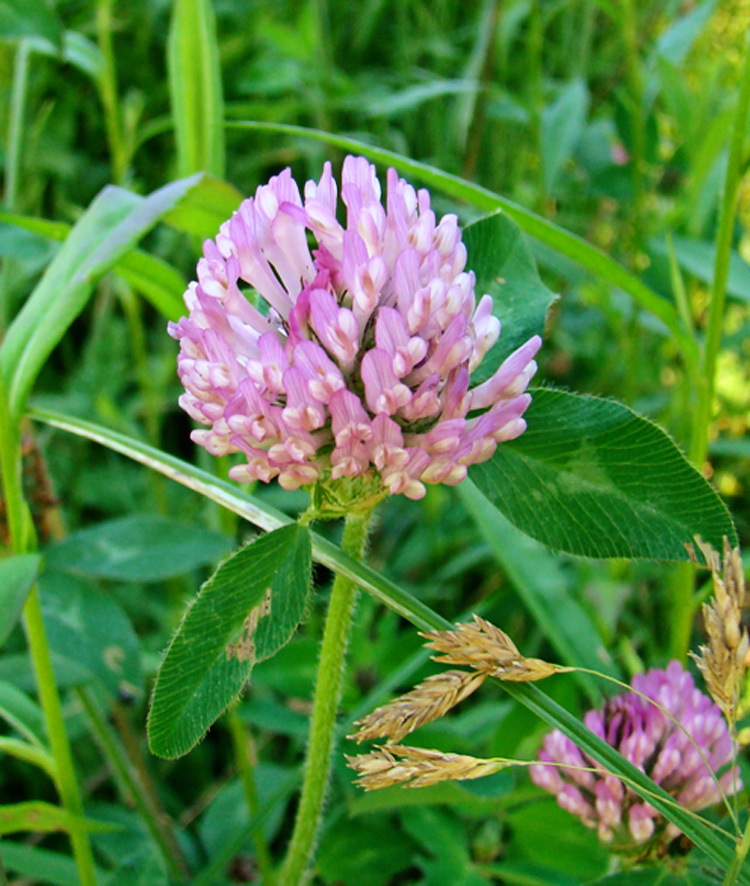
Red clover isn't really red. It's pink.
K2 loves it.
It smells good. It's pretty.
See how there's a lighter green section in the center of the leaves? I think that's neat.
Right now a lot of the lower leaves are sort of gray looking from powdery mildew.
Rumor has it that powdery mildew is caused by too damp conditions, but really it's caused by dry stress, which can be aggravated by heat. Which is what we had here. Which is why they've got powdery mildew.
K2 loves it.
It smells good. It's pretty.
See how there's a lighter green section in the center of the leaves? I think that's neat.
Right now a lot of the lower leaves are sort of gray looking from powdery mildew.
Rumor has it that powdery mildew is caused by too damp conditions, but really it's caused by dry stress, which can be aggravated by heat. Which is what we had here. Which is why they've got powdery mildew.
Labels:
clover,
powdery mildew,
wild flowers
Wednesday, June 6, 2012
Big Daisy
Remember when I told you I had a big daisy that had volunteered in the path next to one of the veg beds?
It got big this year.
Really big. [There's another, not so exuberant, just behind it.]
I think it likes me.
It got big this year.
Really big. [There's another, not so exuberant, just behind it.]
I think it likes me.
Labels:
daisies,
wild flowers
Friday, June 1, 2012
Summer
Summer mornings dawn misty around here. The air is a little bit blue. The dew is abundant.
The cow vetch has been abundant, too this year, like the daisies. Our roads are lined with it. The stems are wiry, but it has lacy looking tendrils, too. It looks all dainty and ladylike, but in reality it's very tough.
This is a field in Newark, Indiana. It takes my breath away.
Labels:
cow vetch,
summer,
wild flowers
Saturday, May 19, 2012
Daisies

It's daisy season. They're everywhere right now.
Fields full of daisies - I love them.
We'll have them in smaller numbers throughout the summer, but right now they're glorious.
They volunteer all over the place. I have two big plants that volunteered right in the middle of the veg garden, in the path, at the corner of a bed. When they bloom, I'll post a pic.
This field is in Hendricksville, not far from Rosie's Diner. It slopes from the road down to the big creek that runs along Highway 43.
K2 snapped these pics on our way to town.
Labels:
daisies,
wild flowers
Tuesday, May 8, 2012
Jack in the Pulpit
This is our south woods. The big creek runs right through it. It's quiet and peaceful and beautiful and we're always finding cool things there.Like unusual wildflowers.
And humongous snapping turtles with their babies hanging on to their backs.
And salamanders under the rocks.
And parts of old tractors.
And not too far away from the creek, there's a sinkhole with two washing machines in it. Weird. One washing machine I can see, but, really. Two??
It's our plan to figure out a way to haul out the washing machines. Eventually. I shudder to think of what else might be down there.

Anyway.
This isn't about the sinkhole or the creek or the turtles.
It's about Jack in the Pulpit.
Lily found them - just a few.

They camouflage well, don't you think?
Labels:
creek,
jack in the pulpit,
wild flowers,
woods
Subscribe to:
Posts (Atom)