Showing posts with label pollen. Show all posts

Friday, May 29, 2015

Bees on Asparagus Flowers

Once the asparagus got tall, it started to bloom and once it started to bloom, it started to buzz. 

There are always a few bees in the asparagus forest.   They have to work hard to get this pollen.


The pollen is dark orange and they never have much of it in the pollen baskets on their legs.


Must be good stuff though because there are always a few bees in there.

Saturday, May 4, 2013

April Bees


The hive has been really busy.  Last week I sat for a bit and just watched the bees bringing stuff in. 

Here you can see some brown pollen and some yellow pollen coming in. 

I'm sorry the pics aren't better, but these guys are fast and they don't stop and pose for the camera.   I'm still working on that.


More of that brown pollen.   From some tree, I think. 


In the half hour I sat and watched the hive, there were a lot of traffic jams.   


I love this bright orange pollen.  Bees with this stuff were frequently covered from stem to stern with pollen - from dandelions.

Now that it's warm, it's time to do a full inspection and soon I'll do a split to get the other hive going again.


Monday, April 8, 2013

Pollen

The trees are blooming and a lot of pollen is going into the hive. 

I'm pretty sure the greenish stuff is maple pollen of some kind.  We have maples close by and they're blooming now.

The orange pollen could be daffodil.


These guys are loaded.  Sometimes there's quite a traffic jam at the entrance.


More of that orange pollen.


Three bees with the maple pollen. 

All of this pollen is very good news.  It means there's brood in the boxes.  Brood means a good queen and a build up of new bees, which means more bees later and more honey.

No drones yet.  The first brood of the year is females - to build up the hive for the season.  Later they'll raise drones.  Our plan is to split this hive as soon as we see drones. 

Wednesday, April 3, 2013

More Scilla

If you're tired of pictures of scilla and blue pollen, then I apologize. 

The truth is that I love scilla.  It's my favorite flower and my favorite color.  

This is the color of butterflies singing.

Plus, blue pollen is cool.  

Plus bees collecting blue pollen is cool.

Plus these flowers mean the weather is cool.   Instead of cold.  


And sometimes it means that the weather is warm. 

Ish. 

So I love scilla.  

And I love new fuzzy bees on scilla.  

Click on the pic to blow it up to see how fuzzy she is.   And notice that gorgeous blue pollen on her leg.


Monday, March 18, 2013

More Blue Pollen


A few days ago I posted a pic of a bee on scilla with blue pollen.   I posted it to the bee forum and some of the beeks expressed some doubt that the pollen was blue.

You know who you are.

So,  I got some more pics.

And no, I didn't doctor them.  Geez. 

Bees gather pollen and put it in pollen baskets on their back legs.  It stays put there until they get it back to the hive.   Check out the pollen on the legs of these bees.

What do you think?    Is it blue?


Friday, March 15, 2013

Frames of Pollen


The temps were over 65 degrees last weekend and the bees in the lang were happy.

Seriously happy.

I took the insulation off the side of the hive to let the sun warm it and within an hour there was a mass exodus of bees on cleansing flights.    It was awesome. 

Since the other hive [Tardis] died, I had a lot of frames of honey and stores to do something with - I'd just as soon the bees use it.     I went through all the frames in the Tardis to see what was left in the hive.   There were a lot of partial frames of honey, some full frames of honey and three brood frames with a considerable amount of pollen stores.

Pollen is at a premium this time of year.   The scilla and crocus are blooming, but the willow and maple haven't started yet.   The bees in the lang can use that pollen.

So, I decided to put the three frames of pollen in the lang.   The problem is that the frames of pollen are deeps, but the top of the lang is medium.   

Not to worry.   I already had an empty medium over the tardis to protect the candy, so I added another one.   I hung the deep frames in the top medium and they hung down past the bottom into the top of the medium below that was protecting the candy.  

Works great.


Now the lang has ready access to pollen right upstairs until the maples and willows bloom.   This will give them a bit of a head start.  

I'll be doing splits from this hive this year as soon as it warms up, so an early build up will be a good thing.  


Tuesday, March 12, 2013

Blue Pollen

The bulbs are starting to bloom in a big way now and the bees are starting to get out and about.  


The bees found the scilla and started collecting the blue pollen.  


You can see the gray blue pollen basket on this one's leg.

Bees only gather one type of pollen at a time.  They take it back to the hive and store it to feed to the brood [larvae] throughout the year.  

Tuesday, July 31, 2012

Bees Love Hostas

The bees loved the hostas this year.   They completely ignored the lavender and hung out all over the hostas instead.    Interesting.

If you blow up the pic you can see her all covered with pollen.

Thursday, May 3, 2012

Flower Lang - Day 26: Comb Issues

It was great to have Lily there to do the camera thing so we could focus on the bees.    Thank you, Lily!

I've divided the inspection into two posts this time -- one post for each hive -- so I can talk about different things without overloading you with bee info.   We'll start with the Flower Lang.

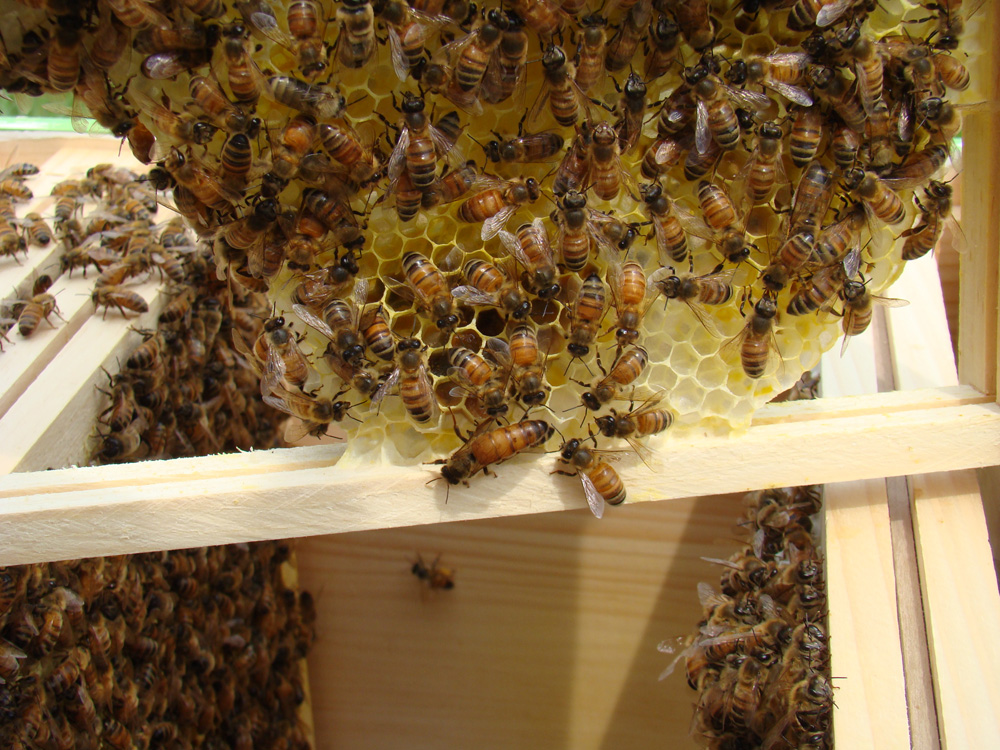
The Flower Lang has comb issues. 

They're the ones who built the extra comb on the side of the hive.   We've had to do a lot of comb repair in this hive.    Mostly because they're building wonky, but once because I broke a comb off.   Last week we repaired 4 combs.

This is what we found when we opened the hive this week.

See how it's bent? 

It's not supposed to be bent like that.


That's one of the combs we repaired last week.  It looks like the comb rolled sideways a bit and crumpled at the bottom.   Soft comb'll do that.

In the meantime, the bees started a new comb from the top.  They'll meet soon.

This is the other [south] side.   I'm pretty sure that's drone comb at the bottom between the rubber bands.   Drone cells have domed caps, they're wonky sizes and irregularly placed. 

We decided to bend that soft comb back straight and cut out the crumpled stuff at the bottom.  


I used a knife to cut out the crumpled stuff at the bottom of the north side.  

Notice that I left the bees on while I worked.  They're much happier that way.

Much.  Happier.  


This is what it looked like when I was done.


Last week's repair.  This is a frame that we repaired last week.  I think it's the one I broke.   It stayed put enough for the bees to draw all that new comb above it.   There's lots of capped brood under those bees and eggs in the new edge comb.


That blasted end comb.  Once again, the bees got creative with the end frame.    We cut the little part out and then cut the big comb out and put it between two rubber bands to center it on the frame.   Hopefully they'll get it straight in the frame.   I'm not holding my breath. 

The good news is that we are getting a lot of experience doing cut-outs...sort of.   Only I'd be happier if we weren't cutting them out of their own frames.


Queen.  Here's the queen at the bottom of the comb just getting on the wood frame.  It's easier than I thought to find the queens.  The other bees give the queens some space.  The queens don't hurry, but they're always on the move.

Eggs.   We saw plenty of eggs in the brood comb where the first batch had hatched already and in the new comb.    This is new comb.  Blow up the pic to see eggs and some small larvae.  The eggs look like rice; the larvae look like the letter C.


Here's a better pic of some new eggs.  They really showed up in this piece of comb.


Frozen Brood
At the bottom of the hive we found a little piece of comb that had broken off [sorry no pic!]  In it were two small/medium larvae, dead and black. Way too small to have been capped.  It smelled a bit rotten.   I stuck a twig in it to see if it would string out [like American Foul Brood does], but it didn't much.    I guessed that this bit of comb broke off before the freezes we had early last week and that these poor guys got frozen.   A bit of internet research netted me this fabulous chart which confirmed that it was likely that these guys had indeed died from the cold.  


And now a gratuitous pic of a big pollen basket.  Look at the size of that thing! 

If you're interested in what color pollen comes from what plant, check out this wiki page.  


Tuesday, April 17, 2012

Bees - Day 12 check

We were so excited to do our first real check of the hives.   This time we put on our veils because we weren't sure how docile the bees would be. 

And we used the smoker.    Can I just say right now that so far the hardest thing about beekeeping is keeping the stupid smoker lit?   Geez. 

The first hive we checked was the Tardis.    We took out two empty frames on the far end so we'd have room to move things around and put them on the frame holder outside the hive.    Then we took out each frame in turn to see how things were going.  When we were done looking at it, we put it back in the hive scooted over to the side so we could pull out the next one.

We were happy to find 6 frames partially filled with comb.

It was beautiful.

White, white comb.   Covered with bees.   The bees on this comb were thick and we had to brush them off to see anything.

See that bright red pollen cell in the center?  They keep some  pollens separate.  Some is red, most is yellow, some is creamy.


So we brushed them gently into the hive.   And underneath, on the bottom halfs of the combs we found lots of eggs.

If you blow the pic up you can see what look like grains of rice in the cells.  Those are eggs.

That yellow thing?   Pollen.

At the top of each comb we found glistening stores of uncapped honey and below that loads of pollen.

Honey is concentrated by evaporation, eventually it will reach the right concentration and then the bees cap it so that it doesn't become diluted by the humid air.    Cool, huh.


We saw lots of different pollens on the bees.


Here's some white.   Look at the size of those baskets.


And here's some yellow.

I wanted to get some better pictures, but the bees move constantly and quickly and it was really hard to get anything decent.  I'll keep trying.   You wouldn't believe the size some of the pollen baskets get.


Anyway, we looked carefully through all 6 frames for the queen, but never found her.    I wasn't surprised.   It takes a certain skill to be a queenspotter and I imagine that will take time.

When we were done, we put the frames back where they were, pushed them tightly together, put the lid back on and moved to the Flower Lang.

We lit the smoker, again.   Opened it up and the first thing we saw was a bit of burr comb on the south side.

That comb running perpendicular from the frames to the side of the box, doesn't belong there.

Rookie mistake.   When the frames are all in the box, there's still about an inch of wiggle room.   You need to push the frames together to one side or in the center so that you won't get burr comb.

I pushed them to one side - the north side.   But the bees like the warmer, south side to put their brood against so, they built comb where they wanted it.

The bees will do what they want and not what you want.

We started at the other end of the hive and left the burr comb for last.   I removed 3 frames from the other side and started looking at what the bees were doing.

Interesting.    The first frame I pulled out had this in it.   A lovely little piece of comb on the edge of the frame, with bee space behind it and between it and a bigger piece of comb on the other side.

Not going to work. 

And sure enough when I put the frame back in, it fell right off.

Not to worry.   I knew how to fix it.


I put rubber bands around an empty frame like this.


Then I tucked the comb in the frame with the rubber bands to support it.


Neat trick, huh!   I learned that by watching vids on the forum at beemaster.com.   

The comb will stay there quite nicely and the bees will fill in around it, where I want them to.

Now that comb on the other side of the first frame we pulled out was too far to the other side. 

So I took a knife and carved it down level with the top of the frame so it wouldn't bump out.

I was afraid that these two combs were wonky because all the others were first, but when we looked, the ones in the middle were just fine. 

Lucky.

We took out all the other frames and looked at them and they all had plenty of eggs, pollen and uncapped honey.   Then we got to the last one with the burr comb.  

I cut the burr off the last frame so we could take it out.  And this is what we found behind it. 

An entire comb on the wall of the super.   With bee space behind it.

It had to come out.    So I put my gloves on because there was no way I was going to get all those bees out of there first,  and I wanted to concentrate on getting the comb out not not getting stung because I crowded the bees.


I cut straight down the side of the super and was happy to see that it was connected by only 3 inches or so of wax.  

You can see the section that was connected.   It looks like the bottom stroke of a capital Q in the pic.

This frame was all pollen and honey.  No eggs.  No surprise.  No room to move around much.  Plus, the bees typically keep the stores to the outer edge of the hive and the brood in the middle.

I repaired this comb the same way I did the other, by tucking it between rubber bands in a frame.   Then I put that frame back on that side of the hive, only I pushed the frames tight together on that south side this time.   Hopefully the bees will get the hint.

When the bees fill this frame in, they'll chew the rubber bands off, or when I go back in, if there's plenty of comb around this one supporting it and connecting it to the frame, I can clip them off and get them out of the bees' way.


All in all, it was a very interesting inspection.    We found no capped honey or brood yet in either hive, but it's only been 12 days.   We'll do another frame inspection next weekend and we hope to find plenty of capped brood and capped honey.  

In the meantime, I have got to spend some quality time with the smoker practicing keeping it lit. 
Related Posts Plugin for WordPress, Blogger...