Showing posts with label sumac. Show all posts

Wednesday, March 4, 2020

Tulip Poplars and Sumac

© Robin Edmundson, 'Tulip Poplars and Sumac', watercolor, 18 x 24 inches.
Framed to 24 x 32 inches.  $750.

Some pieces take longer than others.  I did the first draft of this one waaay back in the fall and loved some things about and really didn't love others.   Mostly I loved the way it *felt*.

I showed it to a few other painters and got some feedback, which I didn't agree with, so I set it aside to think about. Eventually, I came back to it and tried a couple of things which didn't really work, so I took the advice I was given and discovered why I didn't agree with it.   In doing that, I learned a few extra things, so the experimentation was well worth the risk and result of a dud painting.

I painted another draft, tried more things, learn more things and was still not happy with the result.  So I painted another one.  And another.   And another.  And another.  And then this one.

I don't love this one as much as I find it interesting every time I see it. The version before was a bigger hit with the family, but this is the one that best says what I want it to say. 

The two versions sat side by side for a few weeks while I decided which I wanted to frame for my upcoming show.  Do I choose the one that is more popular with the viewers [and thereby has a better chance to sell?]  Or do I choose the one that most delights the artist? 

I chose this one.   I am delighted.

Wednesday, December 4, 2013

Bedecked

Our sumac this year has been gorgeous.   The drupes are velvety red and can be cut and brought inside for beautiful arrangements.   They look really pretty with that cedar.   Plus, they're not poisonous, so you don't have to worry if a berry drops into the soup.


They also look pretty with rosehips.   Red, red, red.


I think the rosehips look pretty on their own, too.

Wear gloves if you go collecting rosehips.  Lots of thorns.   [It's worth the trouble though.]

Wednesday, October 2, 2013

Edible

These are elaeagnus berries, also called autumn olive.  You won't see them in the grocery store, but you will find loads and loads of these growing wild out here.  They're delicious and nutritious.

But don't just take my word for it.

Once in a while I get an email from someone asking me How I Know something is edible. 

It's a good question.  

I know things are edible or not because I Do My Research.  I see cool stuff on blogs all the time, but I never, ever try a new food before I do my own search and have several sources that say a food is OK to eat and that it has no known side effects [psychotropic berries, anyone?].  Only then do I offer it to my kids to eat, too.  

Just because native Americans used to eat something is not a good enough reason.  Look what happened to them.

I always double check through poisonous plant lists.   Just do a search with the name of the plant and 'poisonous'.   Then do a search for the plant and 'edible'.  


I look for recipes used by normal people today.   Once I find several people who have used that plant and had good results, then I feel free to experiment all I want. 

We've found some terrific, delicious wild things around here that our family loves.   It's sumac season right now.   Soon there will be jars of drupes soaking for our favorite early fall treat. 

Saturday, August 10, 2013

Winged Sumac

We have a bunch of sumac on this place.  We love to soak the berries for a delicious drink. This year we noticed that the Smooth Sumac blooms much earlier than the Winged Sumac. 

This Winged Sumac - Rhus copallina  [also called Shining Sumac] is blooming just now - a bit late.  The Smooth Sumac bloomed in June.

Here's a good shot of the leaves of the Winged Sumac - notice the 'wings' that grow along the twigs between pairs of leaves.   Smooth Sumac leaves don't have that.

We are at the northern edge of its range - looks like it has a Zone 5B winter tolerance.

Monday, January 14, 2013

Winter Sumac

The structures of these smooth sumac trees remind me of dancing Thai ladies.   You know the ones - they have those pointed gold hats and they look like their hands are all curling around and snake-y.  

Click the pic to biggify and see if you can see what I'm talking about.    Maybe it's just an illusion that happens when you walk past them and they appear to move.  

The 'tassels' at the tops are last year's drupes.    Our bees love these trees - and I mean LOVE them.   They cover the flowers as soon as they open.  Last year we had a poor season because of the heat and drought.  I'm excited to see what happens this year with them.  


Tuesday, June 26, 2012

Bees Like Sumac

We have good land for sumac.  [Great wiki article on all the varieties of sumac here.] 
Most of the sumac we have is rhus glabra - smooth sumac.   It makes great 'lemonade'.  I've experimented a lot with it.  Read about it here.

Last year we noticed a new patch of sumac that was a little shorter, a little different.  It turned out to be staghorn sumac, rhus typhinus.  The staghorn sumac is blooming right now and the bees are all over it. 

All. Over. It.

This is good!  This means that we've got something to continue the nectar flow for the bees through the summer.   I'm hoping that when the smooth sumac blooms, the bees will be all over it, too.   It will bloom later.   I'll keep you posted.  I've heard that sumac honey is dark and reddish.    When we did our last inspection, I found a little patch of dark red honey on one frame.   I'm thinking it was sumac.  

The nectar flow is the time of year when plants are blooming and producing a lot of nectar for the bees to turn into honey.   The biggest flow is in the spring when the trees are blooming.   Then it slows down in a lot of places.  Most places make honey in the spring, then harvest it, then let the bees build up their own honey stores through the rest of the year to get them through the winter. 

At our place here, we have a lot of honey locusts, tulip trees, and autumn olive.   Then there's a short lull until we have our acres of wild blackberries bloom.  Then a short lull until the white sweet clover and staghorn sumac bloom.   Then, hopefully, the smooth sumac.  Then the goldenrod.   

This means that our little area right here might be pretty ideal for a steady long flow from spring until fall.   Who knew??  I'm watching the bees carefully to see what plants they're working.  


Tuesday, September 13, 2011

Sumac

Winged sumac bob
Sumac shrubs [Rhus sp.] are invasive around here [southern Indiana].    They grow from the root rhizomes - like iris do - to form large clonal colonies.  The short trees get about 15 feet tall when they're really happy.  The branches ooze a white sap when cut.  The good news is that they're attractive and the ripe red berries are very useful. 

The branches bloom and form dense clusters of red berries, called 'drupes'.  The name 'sumac' comes from the Old Arabic word for 'red'.  The cut branches make a beautiful fall arrangement that will dry on its own and last for months.  The dried drupes have been used throughout the world as a cooking seasoning [sumach] and they are very popular in middle eastern cooking.   We harvest the drupes to make the best lemonade you can imagine.

There are three common varieties of sumac here:  Smooth sumac [Rhus glabra], Winged sumac [Rhus copallina] and Staghorn sumac [Rhus typhina].   Staghorn stems and drupes are covered with fine velvety hairs.  Winged sumac has little wings that grow up along the twigs between sets of leaves. Smooth sumac is .... smooth.   No hairy stems or drupes.  The red drupes of the smooth sumac are often covered with a milky or waxlike substance - it's delicious!

Note:   A lot of people freak out about these plants, believing that all sumac is the poison sumac.   Poison sumac has white or gray berries - 'Berries white, take flight!'.   Not red berries.  Not red berries covered with milky wax.   It's easy to tell these plants apart.   Really easy.  

Winged sumac with bobs
Sumac spice.  To harvest the drupes to use as a spice later, cut the clusters, called 'bobs' and lay them on screens or sheets to dry.   When the drupes are good and dry, rub them off the twig and put them in jars.  Save the little hairs of staghorn sumac - they're tasty! This spice lasts for a long time.

Smooth and winged sumac drupes are often waxy or covered with a milky substance.  The best flavor is in that wax but it's tricky to get it dry enough to store.    Be patient.  Keep them in a very dry place.

Lemonade.  Our favorite way to use sumac is in lemonade.   Here's how:

Sumac bobs soaking for lemonade
Cut the bobs - the waxiest ones you can find - oozing the white stuff over the red [or purplish] drupes.  [If you're using staghorn sumac, then go for the hairiest ones - that's where the flavor is.] Remove all the leaves.  Do NOT wash the berries - you'll wash the flavor off.

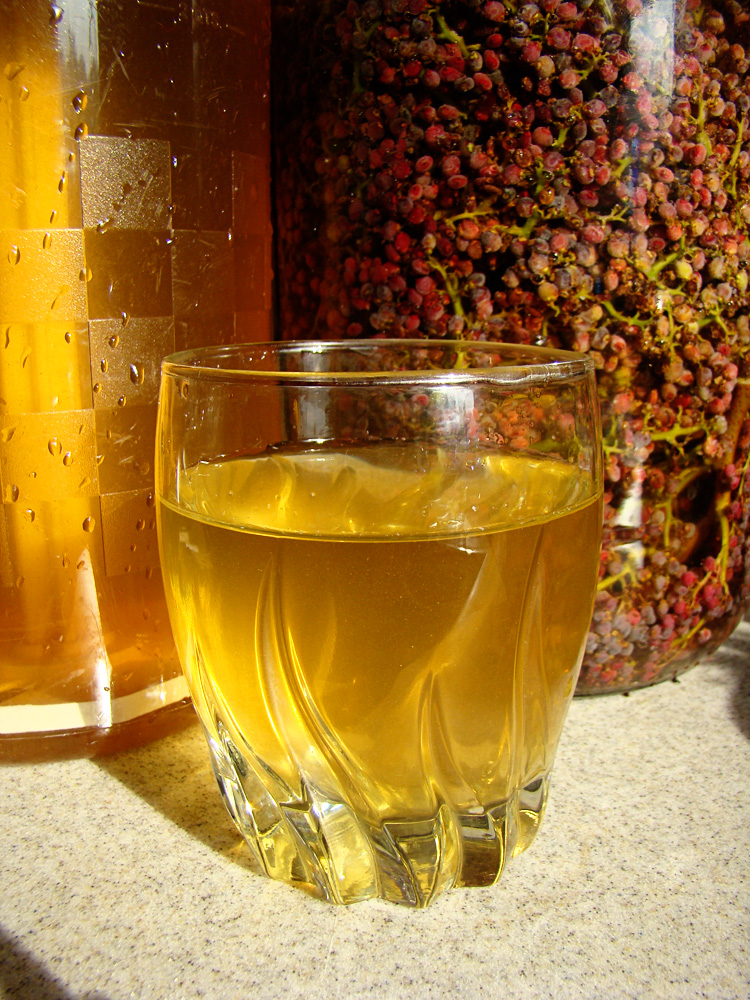
Pack the bobs into glass gallon jugs - pack them tightly.   Fill with cool water and set them in the sun for a few hours.   If the weather is cool and cloudy, then use lukewarm water and soak them overnight.  

Note:  Do NOT fill the jars to the top.   As they soak, the bobs release bubbles and the jar will overflow if the water level is too high.   You might want to put the jar in a dish to catch the overflow. 

After a few hours, the water will be a beautiful light amber color.   Strain the water through a fine mesh tea sieve as you pour it out of the jar.  It will be cloudy for a while.  Don't worry about that.  We got just over 2 quarts of juice from each of these jars.

Add 1 to 1 1/2 cups of sugar to sweeten [to taste].  Stir well and enjoy.   This is the best lemonade ever.  I much prefer it to regular lemonade. 

Sumac lemonade
Freezing.   I have had excellent success freezing the juice and using it months later to make lemonade with.    If you can spare the freezer space, it's worth freezing the juice.

Concentrate:  To concentrate the juice, soak a gallon of bobs the first day, then use that same water to soak another gallon of bobs.   Remember, the longer you concentrate, the more likely you are to introduce bad stuff into the water.   I don't concentrate unless I'm going to cook with it and it will be pasteurized in the cooking.

Canning.   I have tried to can sumac juice so that I wouldn't have to use my scarce freezer space for juice.  I concentrated the juice, then I boiled it and put it into jars and processed them for canning.   It worked beautifully - but the flavor was changed in a significant way.   I don't like the cooked juice nearly as much as I like the fresh juice.    If I want to preserve sumac juice, I'm going to freeze it.

Experimenting.  I used some of the concentrate to make sumac jelly and to make sumac lemonade bars [with a lemon bar recipe].   In both cases, the wonderful subtle flavor of the juice was lost.   The sugar overwhelmed the flavors and the finished product was unimpressive and too sweet.  

Other uses.  Sumac leaves have a lot of tannin in them.   Rumor has it that they're good for dyeing and will give either a yellow dye or grey dye depending on the fiber and mordant.   Someday soon, I'm going to use the berries to dye with.   I'll let you know how it turns out. 
Related Posts Plugin for WordPress, Blogger...