Showing posts with label garden. Show all posts

Saturday, June 5, 2021

Blue & Purple flowers

© Robin Edmundson, 'Blue & Purple Flowers' 959, watercolor, 9 x 12 inches.  Framed $300.


I can't wait for summer flowers in the garden.  Can't.  Wait.

The spring irises came and went and the roses are almost done.  I've got phlox and penstemon.  The veronica has just started and there are big buds on the echinacea and snapdragons.   I can feel them calling me to get ready.

What are your favorite flowers? 


Saturday, April 18, 2020

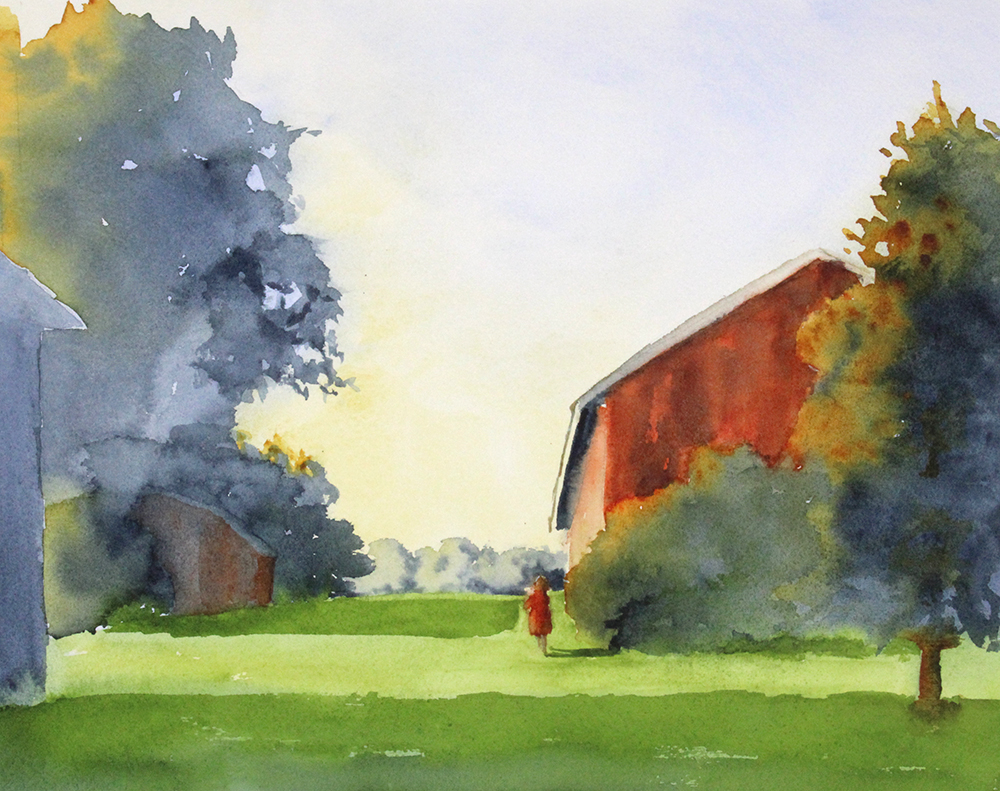
Red Dress

©Robin Edmundson, 'Red Dress', watercolor, 10 x 13 inches.  
[Available framed, $375]

I've been thinking a lot about summer mornings.  The ones when you get up at sunrise [Do you do that?] and the air is still cool.  I go for a walk and listen to the birds and the trees and then come back and head over to the gardens.   The last of the peas are high on the plants, wet with dew and I get a shower as I pick them.  The tomatoes are thinking about turning.  The greens are crisp. The beans are getting taller.  The earliest sunflowers have big buds and the little ones will be blooming soon. 

I love those mornings. 

Thursday, September 12, 2019

Zinnias

© Robin Edmundson, 'Zinnias #4', watercolor, 15 x 11 inches.
Framed to 20 x 16 inches.  $375.

I plant a long row of zinnias every year.  They make me really happy.

I like the big ones.  And the small ones.  Also, the ones that look like cactus flowers and the ones that look like fat pompoms.  I like the red ones, the orange ones, the yellow ones and the pink ones.  And this year I got a couple of white ones that knocked my socks off.

While I was practicing a few versions of this piece, Claire walked in and looked at an early one and said, 'Frame this.  I want it.'   She's allergic to a lot of the outdoors, 'This way I can have them in my room.'   [Of course, I framed hers first.]

This piece and a few more florals will be hanging at my upcoming show at the Vault at Gallery Mortgage in Bloomington, Indiana.  October 2-29, 2019.


Robin Edmundson: Not Far Afield

October 2-29, 2019

The Vault at Gallery Mortgage
121 E 6th Street
Bloomington, Indiana
Gallery Hours:  M-F 9am-5pm

Please join us for the opening reception
Friday Oct 4, 2019
5pm - 8pm


Saturday, June 16, 2018

Monday, January 1, 2018

What I grew in 2017

Beans: [Dvds on strings really scare the birds away!]
  • Purple Teepee - Pole beans.   Loved them from 2016.  Easy to shell.
  • Kentucky Wonder Pole beans:  Flat and strings.   Prolific.
    Flowers:  zinnia (loads!), calendula, cosmos, tithonia [love this!!], sunflowers, batchelor button, agastache.

    Garlic:
    • Chesnock Red
    • German Red
    Greens:
    • Arugula
    Herbs, Annual:
    • Basil, Genovese
    • Genovese red basil
    • Basil, Sweet Blue.   Great bee plant, tea plant and makes the whole garden smell wonderful all summer. 
    • Cilantro, Slo Bolt.  Got original seed from BC.  Now I use our saved seed. Mostly it self sows.
    • Dill.  Self sows now
    Herbs, Perennial [ongoing plantings]
    • Lavender - mulched with gravel 2016.  Made a huge difference in how bushy and big the plants got.   
    • Thyme - will plant in front of lavender.
    • Sage - loves the gravel
    • Chives
    • Anise Hyssop
    • Hyssop
    • Chamomile [self sows]- must plant more.
    • Alpine Strawberries
    • Costmary
    • Lemon balm
    • Sorrel
    • Purslane: volunteers.
    • Oregano
    • Echinacea
    • Comfrey 
      Peas:   Sugar Snap.   Did not do well.

      Peppers -We're shooting for sweeter, meatier peppers this year.
      • Jupiter pepper.   
      Radish:   

      • Early Scarlet Globe
      • French Breakfast

        Squash, Summer
        • Zucchino Rampicante - Got one.
        • the rest of the summer squash got eaten by borers and squash bugs
        Squash, Winter: Going to try them in a bed that has been covered in black geotextile.
        • got none
        Berries
        • June bearing strawberries
        • Ever bearing strawberries
        • Blackberries - good ones from Stark Bros.   Keep all side shoots pruned off up to 3-4'.
        • Raspberries - these need a ton of water, so will be watering almost every day.
        • Elderberries - Wild.  Wonderful.  
        Tomato
        • Amish Paste:  Good standby.  Roma type.  Does OK with septoria.
        • early girl:  did great.  Deer ate them all at the end of the summer.

        Fruit trees
        • Sweet cherry
        • Sour cherry - good!
        • Apricot - none
        • Plum - got one
        • Peach - none
        • Fig [Chicago Hardy] - got about 30.

        Sunday, July 30, 2017

        Rudbeckias


        The view from the top of the garden looking down toward the road.  The rudbeckias are in full swing and the garden is golden for the next few weeks.  

        Friday, June 30, 2017

        Purple Carrots

        Photo: Lily Jenness [my oldest kiddo]
        I have four sisters.  They are some of the most interesting people I've ever met.  This year, one of them decided this was her 'Year of Yes'.  Yes to new things, people, experiences.  A year to stretch that comfort zone.   This is remarkable because by and large we are a family of introverts.  Introverts with really great social skills.

        My word for the year is 'Magnetic'.  It's a powerful word, full of import.  I have been careful to behave in a way likely to attract things that are long-term sustainable and healthy.   It has also really stretched my comfort zone.

        I found myself trying things one more time.  Re-framing a problem.  Changing a mindset.  Looking at things in new ways.   Being brave.  Trying new things.  Trying again.  And again.  Sharing, sharing, sharing.

        Which brings me to the carrots.   I have planted carrots a dozen years and gotten nothing but knotty, bitter, buggy, nasty things.   But I found a packet of seed for the purple ones this year when I was planting everything else and thought, 'Well.  I've got room for a small row in a new place.  We'll try again. One more time.'

        Et voila'!  Some of the most beautiful carrots ever.  And get this....They're DELICIOUS, too.  

        So here's my gift to you:  Whatever it is you've been thinking about - Try one more time.  Think about it in a new way. Say, 'Yes'.  You already are magnetic.

        All my love to you-
        R

        Tuesday, June 20, 2017

        Garden Bounty


        Pea flowers are some of my favorites.  I like the shape and I like that pea flowers soon mean pea pods.

        Yum.

        Our favorite variety is Sugar Snap Pea.   They're prolific, last a long time and are delicious whole-pod small, large or as shelled peas.  [But don't kid yourself.  I never wait until they're ready to shell.]

        We're starting to get peas now, but the early heat has slowed them down.  I'm still holding out hope that with regular watering, we can get a bunch more.  They're my favorite.


        Friday, June 16, 2017

        More Hive Art

        © Robin Edmundson, 'Beehives #2', 18 x 22 inches framed.


        Once I got started painting the hives, I couldn't stop.  There's more coming!   Here's a different view of my apiary.   I used softer greens and did a ton of editing as I worked it up.   [Always an adventure!]

        I learn something every time I put brush to paper.


        Framed, 18 x 22 inches.  $350.  Come see it in person at the show.

        Tuesday, August 9, 2016

        Garden Bounty

        The garden is booming this year - with sunflowers.   Everything else is a little unhappy about all the rain.   We have rampant romularia and other fungal problems in the rhubarb, beans, tomatoes, etc.   Plus mega bug problems with the eggplant and squash.


        But the sunflowers, zinnas and marigolds are glorious.  And for that I am very happy.


        Wednesday, March 9, 2016

        Successful Start to Spring

        We took advantage of the glorious weather yesterday and started working for real on our spring To Do list.  

        After losing a couple of buckets of sap to an over-curious dog, we still were able to end up with 6 pints of syrup.   Yum!   To see how we boil, check out the links in the sidebar.   It's an all-day and very smoky affair.  We make an event out of it.

        While we were outside, I planted some peas, favas, radishes and arugula. It's supposed to be warm and rain for the next 6 days, so the soil should be just right for early peas.

        Lily prepped the milk jugs so I could plant the tomatoes, pepper, eggplant, huckleberries, leeks and onions so they can get a head start on the season.   I tucked everyone in a small cold frame with a glass top.

        Lily and I also inspected The Bees That Lived.   It's a tiny colony.   1/4 the size of a medium box - about the size of a nuc.   I think the reason they lived is that we had a well ventilated quilt box on them.   They still had a deep full of honey below them, but we're switching to all mediums so I pulled the deep and set it aside and condensed the hive space.   We saw the queen - beautiful!, made sure they had enough honey [plenty in the medium], put a pollen patty on top and some extra sugar blocks.   The brood was a tiny patch the size of your fist in 2 places.   They are slow to build up.  At any rate, now they have less space to defend and plenty of stores.  Let's hope the queen gets her act in gear and starts cranking out eggs.

        I had set an unused quilt box on a stack of empty mediums and covered it up completely for the winter.  When we opened it, it was completely saturated with moisture and molding like crazy, even though it was filled with cedar and over an unheated stack of supers.   Good to know!   These quilt boxes are great - as long as they are ventilated!  I used regular construction shims/wedges to prop up one end of the inner cover I put over the quilt box on the bees.   Must have been just right because I didn't see any moisture or mold over the bees.

        Lily and I took our first pings of the season.   That deep of honey I set aside started a bout of robbing.  My girls were pretty defensive and while we were taking care of things, I got pinged on the arm and neck and Lily took one on the ear.   I had to wet blanket the hive and that took care of it.  The rain the rest of the week should dampen any pillagers' spirit and leave my hive to build up - I hope. 

        Afternoon update:  I checked the girls this afternoon.   All quiet on the apian front.   Thank heaven.

        Monday, December 7, 2015

        Garden Huckleberries Final Report

        I told you at the beginning of the year that I was going to plant a couple of rows of garden huckleberries on the advice of one of my neighbors, who loves them for pies. 

        I did my research, was surprised at the fear and skepticism surrounding these little things, but planted them anyway.

        I started them from seed in my milk jugs along with everything else last spring.  They sprouted just fine and managed to evade the puppy destruction experienced by the peppers and most of the baby tomatoes and I was able to get 14 plants in a bed [2 rows] along with the brassicas and some later tomatoes.  I planted them 18 inches apart in wide rows. 

        They bloomed white flowers in small loose clusters at the end of branches, and kept on growing.   And blooming.   The bees liked them and soon there were green berries on the clusters and soon the berries expanded to the size of small blueberries and turned black.   And the little bushes kept on going. And going. And going.   At one point the margined blister beetles attacked.  They go after the leaves, not the fruit. I spent two or three days picking those little buggers off into soapy water and that seemed to take care of it. 

        One of the sites I read through was by a guy who liked eating garden huckleberries right off the bush as soon as they turned black.  Another said to wait to harvest until after the first frost.    I tried one fresh berry in the summer when one cluster was good and black.   It was utterly disgusting.   Think of a blueberry that tastes somehow sort of like an unripe tomato.  

        Hmm.    But that other article had said to wait until after the first frost, so I let them go thinking I'd harvest and make one batch of jam in October and if they were awful, I'd chalk it up to a learning experience and never do it again.

        And October came and the bushes were loaded with black berries.  And it frosted a couple of times and I shanghaied my youngest and we spent 20 minutes stripping the plants of the berries, except for a few for seeds just in case.

        Note:   These babies stain in a BIG way.   Wear junk clothes when you work with them.   The stains do not wash out, which means they are an underutilized plant for natural dyeing.    I got a gorgeous blue on the cloth I used to strain with.   We'll see how fugitive it is and maybe do more experimenting next year.   One very cool thing is that they stain your hands purple, but when you wash your hands with soap, it turns the foam bright screaming blue.  Bright. Screaming. Blue.    I had to wash several times before the foam was the normal color again.  

        The best information on cooking them came from Mother Earth News.   Remember - these are no substitute for blueberries.  You can't just drop a handful in muffins.   They must be softened and sweetened before you use them.

        I got about a gallon and a half of huckleberries from my 14 plants.   I decided since mine were very ripe, I'd skip the baking soda boil recommended here.   I dumped them all in a large pot and added enough plain water to barely cover.   Then I boiled the living daylights out of them for about 2 hours, until they were soft enough to crush with a potato masher.  I crushed and crushed.  When I'd had enough of the crushing, I strained them through cheesecloth, kept the juice and tossed the seeds and skins to the chickens.   Next year I'll save those for dyeing. 

        I made one batch of jelly using my regular jelly recipe - just to taste - and it was.....  Delicious!  And really pretty!   The taste is somewhere between grape and a very bright blueberry.  I had enough juice for three batches total.   Here's the recipe:

        Garden Huckleberry Jelly
        www.rurification.com

        4 cups huckleberry juice
        1/4 cup lemon juice
        1/3 cup Dutch Gel All Natural Lite pectin [You can substitute Ball or Sure-Jel, just make sure it's the low sugar type.]
        2 cups sugar  [or more, to taste]

        Bring huckleberry juice, lemon juice and pectin to hard rolling boil.   Maintain boil for 1 minute.   Add sugar and return to hard rolling boil.  Boil for 1 minute.   Ladle into jars and process for canning.


        Soooo - I asked the family - Will we plant these again?     The unanimous answer was a resounding YES.  They were easy to start from seed.   The plants are easy to grow in our zone 5B heavily amended clay soil.  I basically ignored them all summer long.   The jelly is delicious.   I'd like to try making pie filling with it next year, too.   I will wait again until after the first frost to harvest, then cook them and divide them up for pie filling and for jelly.  

        I will definitely save the spent seeds and skins for dyeing, as well as a bit of the whole fruit to see if there's a difference in color.   Because of the wide difference in color when exposed to acid [fuchsia] and alkali [green to blue], I'm expecting that wools [acid] and cottons [alkali] can be dyed very differently, or at the very least I can get a difference in color on the same fiber with a post dyeing dip in vinegar or ammonia.  We'll see.


        Thursday, June 4, 2015

        Fixing the Rock Walls

        When we moved out here 21 years ago, I turned a weird hill in the yard into terraces separated with rock walls - the rocks were pulled out of the creek.   It was a ton [or 2 or 3 or 4] of work, but the result was well worth it. 

        Alas, the sheep and renegade llama did a number on them one season  and the dogs and cats over the years knocked rocks around quite a bit. 

        Mostly, the problem was that in my ignorance, I backed the walls with posts and planks.   In 20 years the wood heaved forward, pushing the walls right over.

        So.   This is the year to re-do them.   Lily pulled all the rocks down and removed the wood behind them.  Then she reshaped the hill behind the walls so we could fill behind each new wall with gravel.  You can see the guide string in the pic below.  There are four walls and we are almost done with the third one.  


        Lily and I restacked the rock and Claire and I filled in behind each wall with gravel.    The gravel will drain well and not heave.   The walls are too short to need footers and they should stand for a very long time - provided no livestock heavier than a cat gets on them.

        They really make the terrace gardens beautiful.


        Thursday, May 21, 2015

        Potato Bed

        The potatoes are thrilled with the weather - they've really taken off in the past couple of weeks.

        We even found a couple of potatoes we missed in the bed that had been covered by the hoop house all winter.   They were sprouting nicely.   I transplanted them here.

        There's a bit of space left in this bed.  I'll put some sweet potatoes in as soon as they sprout - they've been lollygagging around, waiting for it to really warm up and stay that way.   Soon....

        Tuesday, January 6, 2015

        Winter Garden Soil Amendment

        I miss the garden in the winter and whenever the weather is warm enough to work comfortably, I'm out there fiddling with things.  

        And thinking.  

        Sometimes I just walk around and look and think.  

        In between the thinking, I do what I can to improve the soil.  It's my favorite winter chore.

        We have clay here.  Lots and lots of clay.   It's great for brambles, but not tomatoes. 

        So I built raised beds [see above link] and every now and then we toss some extra organic material in there.   We use a lot of straw mulch, leaves, chicken dirt and sand to break up that clay.  

        This is the rhubarb and pea bed.   I can't move the rhubarb to rotate the bed, so I just make sure to put lots of sand and leaves and chicken dirt in it.  It makes for happy rhubarb.   And peas.   And turnips.  I grew some fabulous turnips in this bed last year.    We just dumped a whole lot of leaves in there.   I can hear the rhubarb smiling already. 

        Saturday, January 3, 2015

        Cold Frame Greens


        I love my cold frames.    We have several and 2 are still going strong, full of greens.    This is the cold frame I made by putting an old glass door over the end of the sweet potato bed.   It took all of 3 minutes.

        Then I planted radishes and arugula.    I heart arugula.  

         It's all very happy in there.

        I put a big piece of plastic over it and tucked it in with bricks to keep the wind from blowing it off. 

        Starting the middle of February, it'll be light enough to start planting our spring greens.   I'm kind of excited for buttercrunch lettuce and radishes. 

        Wednesday, December 31, 2014

        What I grew in 2014

        Beans
        • Fava Beans - Broad Windsor   Didn't happen.
        • Red Chinese long beans - Got original seed from BC.  Now I use our saved seed from 2012.
        • Green Chinese long beans - Got original seed from BC.  Now I use our saved seed from 2012.
        • Dragon Tongue [our saved seed from 2012]  
        • Freshette green bean.  Got the seed from Rural King.
        Beet:  Detroit Dark Red.   Rabbit got them at about 4" high.
        Carrot
        • St Valery
        • Purple
        Cucumber
        • Telegraph
        • Sikkim Cucumber
        • Boston Pickling Cucumber
        Eggplant:  Another bad year for eggplant.   Flea beetles devoured them.
        • New York Improved eggplant
        • Ping Tung Eggplant
        Fennel:  Di Firenze - likes cool weather.   Plant in fall for December harvest and in late Feb for spring harvest.

        Flowers:  zinnia (liliput), calendula [and probably some cosmos.  I love cosmos.]

        Garlic:
        • Elephant:  Died during the winter.
        • California:  Died during the winter.
        • Chesnock Red:   Made it through the winter.
        • Music:   Need to try these 2014-15
        Greens:
        • Arugula
        • Bibb Lettuce
        Herbs, Annual:
        • Basil, Genovese
        • Genovese red basil
        • Basil, Lettuce Leaf
        • Cilantro, Slo Bolt.  Got original seed from BC.  Now I use our saved seed from 2012. Mostly it self sows.
        • Dill.  Self sows now
        • Thai red roselle
        Herbs, Perennial [planted several years ago]
        • Lavender
        • Thyme
        • Sage
        • Horehound
        • Chives
        • Anise Hyssop
        • Hyssop
        • Chamomile [self sows]
        • Alpine Strawberries
        • Clary Sage
        • Winter savory
        • Lemon balm
        • Sorrel
        Leek:  Autumn Giant Leek

        Melon
        • Charentais [cantaloupe] - old seed.  Didn't come up.
        • Uzbek Sweetness Melon  ducks got in and killed it.
        • Sweet Passion:  got 4 small melons before it succumbed to vine borer.
        • White Wonder watermelon ducks got in and killed it.
        Onions
        • Egyptian walking onions - mostly died during the winter.  I think I have one left. [Fingers crossed it makes it.]
        • Yellow of Parma onion:  Nice!!  from seed.
        • Wethersfield red onion
        • Ishikura onion:  Nice!! from seed.
        Parsnip:  Half Long Guernsey Parsnip:   Nice and huge.

        Peas:   Sugar Snap.   Heat tolerant.  Lasted through July
         
        Peppers -We're shooting for sweeter, meatier peppers this year.
        • Golden Marconi
        • Red Marconi
        • Melrose pepper
        • Jupiter pepper
        • Golden California Wonder pepper [beautiful!]
        • Purple peppers [early]
        • Banana peppers 
        • Little Snacking Pepper [orange]
        • Pimento [thick flesh!]
        • Carmen [long]
        Potatoes:  Kennebec,  early ones were great.

        Radish:   Early Scarlet Globe - the regular red kind.   Nice!
        Rutabaga: Laurentian Rutabaga  [First time with rutabagas]

        Sweet potatoes:  Georgia Jet.  From our own starts.

        Squash, Summer
        • Zucchino Rampicante - No new seed this year, so we'll try planting last year's seed and keep our fingers crossed.  Died fast.
        • Golden Marbre Scallop [pattypan]
        • Lemon Squash:  borers got them.
        • Castata Romanesco [zucch type]:  Early set of fruit. Light.  Striped.  First one, June 30.
        Squash, Winter  [The last three are new, the others are from last year's seed.]
        • Australian Butter:  Good in hot climates.   Too cool this year, no fruit.
        • Black Futsu
        • Greek Sweet Red
        • Golden hubbard
        • Honey Boat Delicata:
        • Musquee De Provence
        • Queensland Blue:   Good for hot climates.  Too cool this year, no fruit.
        • Rouge Vif D'Etampes
        • Boston Marrow squash 
        • Galeux d'Eysinee squash 
        • Delicata squash:  Poor fruiting this year.
        • Baby Blue Hubbard - old seed.  Didn't come up.
        Strawberries
        • June bearing [from May's]
        • Ever bearing  [from May's]
        Tomato
        • Amish Paste:  Good standby.  Roma type.  Does OK with septoria.
        • Amana Orange:  Didn't fruit this year. 
        • Belize pink heart tomato:  Nice but vulnerable to septoria.
        • German red strawberry tomato:   Cute!  Nice fruit, but vulnerable to septoria.
        • Uncle Mark Bagby tomato
        • Pineapple tomato:  Nice yellow tomato!
        • Mortgage Buster [from May's]:  Nice, but lost half the plants to septoria.
        • Black Cherry [grape tomatoes]:   Nice!   Prolific and tolerant of septoria.  
        Turnip: Boule d'Or turnip

        Sunday, December 14, 2014

        Friday, October 24, 2014

        Peppers

        Surprisingly, I had good success with peppers this year. 

        They had a bad start with the cold weather, so I bought a couple of starts at greenhouses here and there and when I was ready to plant, I had a nice selection of peppers.

        Then they sulked, so I fertilized them with some Miracle-Gro sprinkles - the slow release kind.   Apparently, the peppers liked it because we had a bumper crop!

        These are the types I planted:
        • Jupiter pepper
        • Golden California Wonder pepper [beautiful!]
        • Purple peppers [early]
        • Banana peppers 
        • Little Snacking Pepper [orange]
        • Pimento [thick flesh!]
        • Carmen [long]

        The purple peppers came on early and bore like crazy.   They were thin fleshed with a lot of seeds.   The banana peppers also bore early and had a lot of seeds.   The Carmens were long red peppers - beautiful and very slow to mature. 


        We got several of the Golden Cal Wonders before frost and they were sweet and beautiful.   I love them.


        The little orange snacking peppers were a surprise, and a delightful one.  The fruit is small, fleshy and had few seeds.   The girls liked those a lot.


        By far, our favorite was the Pimiento Pepper - the classic pimento peppers.  [Yep, those things that the salad olives are stuffed with are peppers].  Most were just a bit smaller than your fist - the one in the pic is a pretty small one.  Thick fleshed, few seeds and great flavor.  We'll do these again.


        Saturday, June 21, 2014

        Thinning

        One of the garden skills I've been working on for the past couple of years is thinning. 

        I'm really good at sowing a lot of seed and then it comes up all green and beautiful and I get really excited about growing food and then I get radishes and carrots that are the size of toothpicks.  

        It took a concentrated effort to actually Pull Some Up so that the others would have room to flourish.  

        It's totally a life lesson for me.  

        Aside from dying inside every time I have to pull up a perfectly OK start of lettuce or arugula or radishes or beets or carrots or .... everything,  I get stuck at trying to decide exactly which ones must go.   

        I finally developed a system where first I figure out how much room I want between plants in the end, then I identify the best plants so I can keep them and then I pull up the extras.    Tiny greens [micro greens] can go into salads if you don't want to waste the starts, or they can go into the chickens or on the compost heap.   No waste.  

        I've been doing better lately and have grown the best radishes in the history of radishes.   Also, I have a row of gorgeous parsips now.    Also carrots.    Also lettuce.    My garden is producing better produce.  

        Which is why I'm sucking it up and applying the thinning lesson to other areas of my life.    It's still a struggle.   I hate to pull things up.    I have trouble deciding which things should go.   When the feeling hits me I take advantage and thin what's in front of me and try not to worry about the rest.  I think very slowly, so I figure it's OK to thin slowly, too.  

        Along the way, there are people who fuss at my choices and I'm learning how to ignore them.    It's flattering to be asked to do things, but it's not always good for me or the family.    Adjustments must be made.    I'm doing my best to adjust and so must everyone else. 

        In the end, the adjustments will pay off and we'll have more room to flourish.
        Related Posts Plugin for WordPress, Blogger...